domingo, 15 de febrero de 2026

How to Watch the Birds That Are Watching You Amazing tips

For resources and a gallery of "my" birds and their preferred foods, scroll to end. 

In my new video, How to Watch the Birds That Are Watching You, I show how to observe, attract, and enjoy backyard birds. You’ll discover succulents that invite birds, best seed mixes (and which to avoid), and simple ways to provide water and shelter.
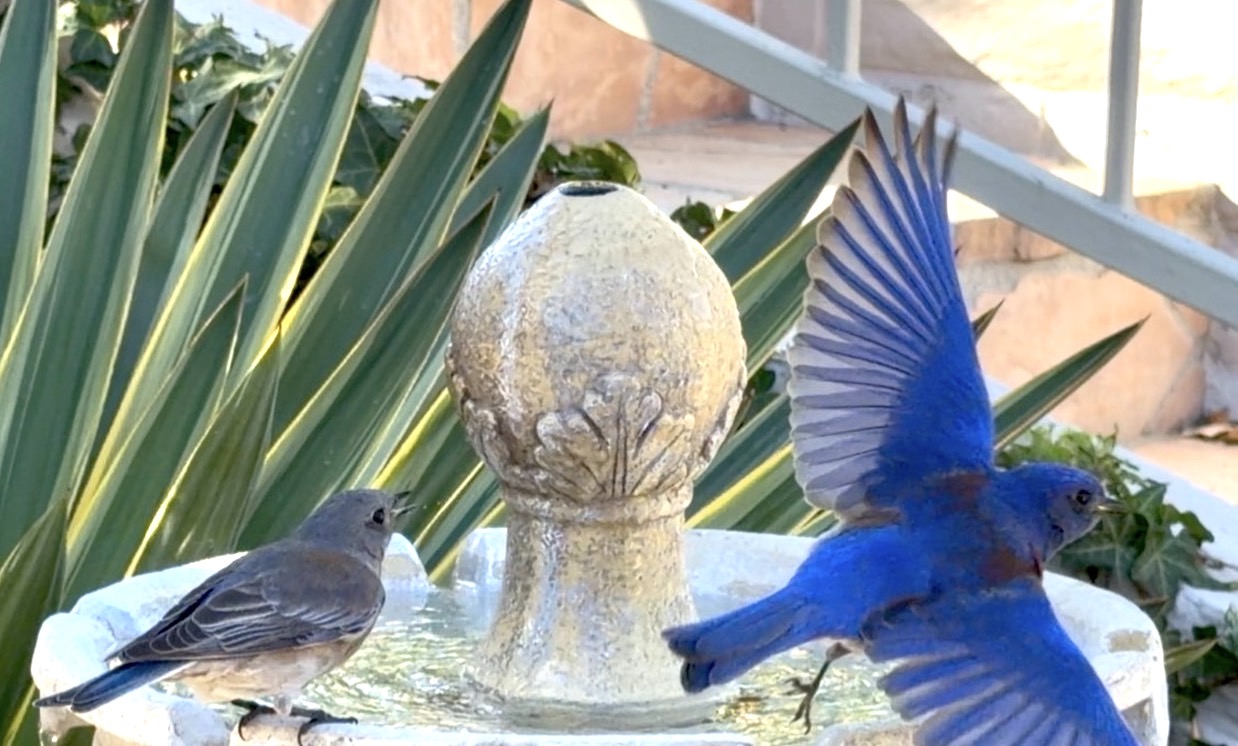
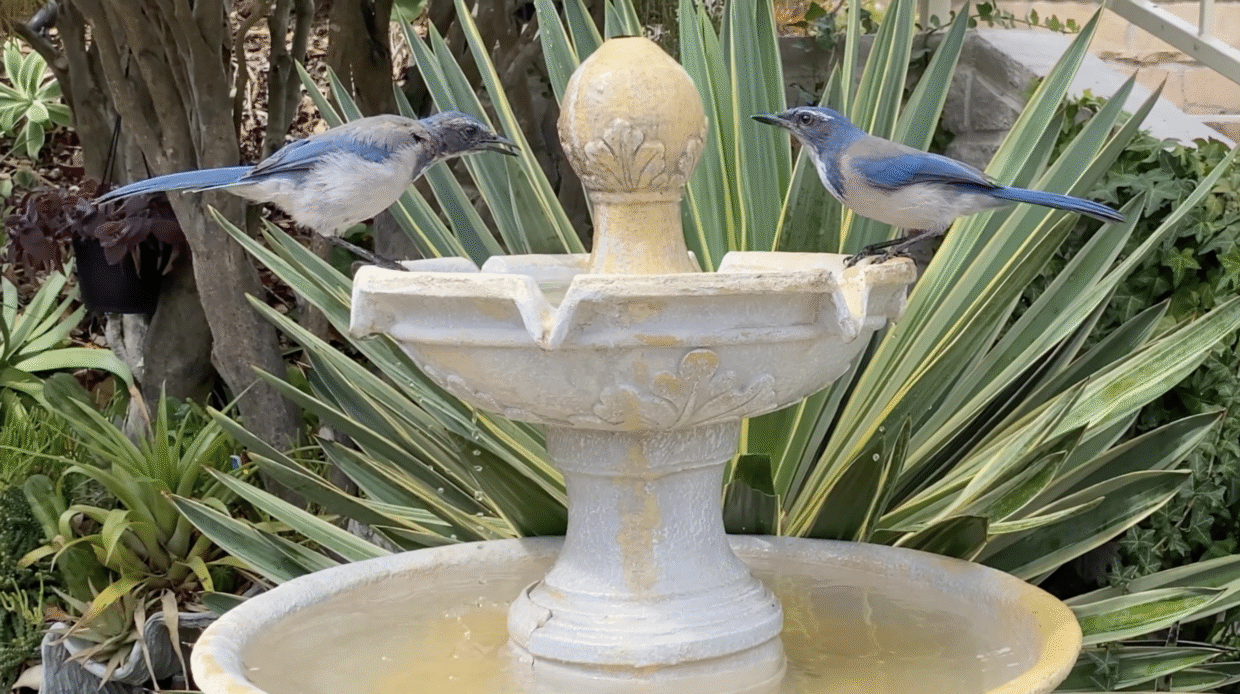
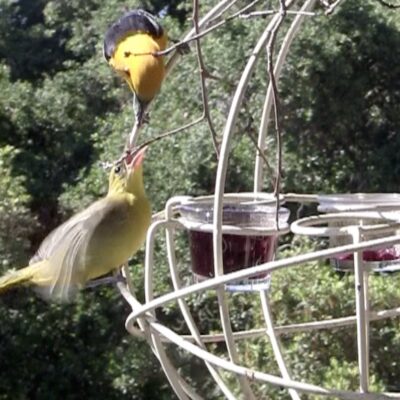
Male bluebird in flight, with female at fountain (c) Debra Lee Baldwin

Right: Male bluebird in flight. At left is a female. They're attracted to moving water.

I'm in the foothills northeast of San Diego, but regardless of where you live, you can do something similar. Wild birds are everywhere! And even common ones are marvelous---"common" doesn't mean boring.

In the video and on this page I share a decade of firsthand experience attracting and observing over a dozen birds common to Southern California and beyond: finches, bluebirds, hummingbirds, orioles, woodpeckers, wrens, quail, doves, grosbeaks, titmice, nuthatches, jays, munias, and more—all in my waterwise, succulent-stuffed garden.
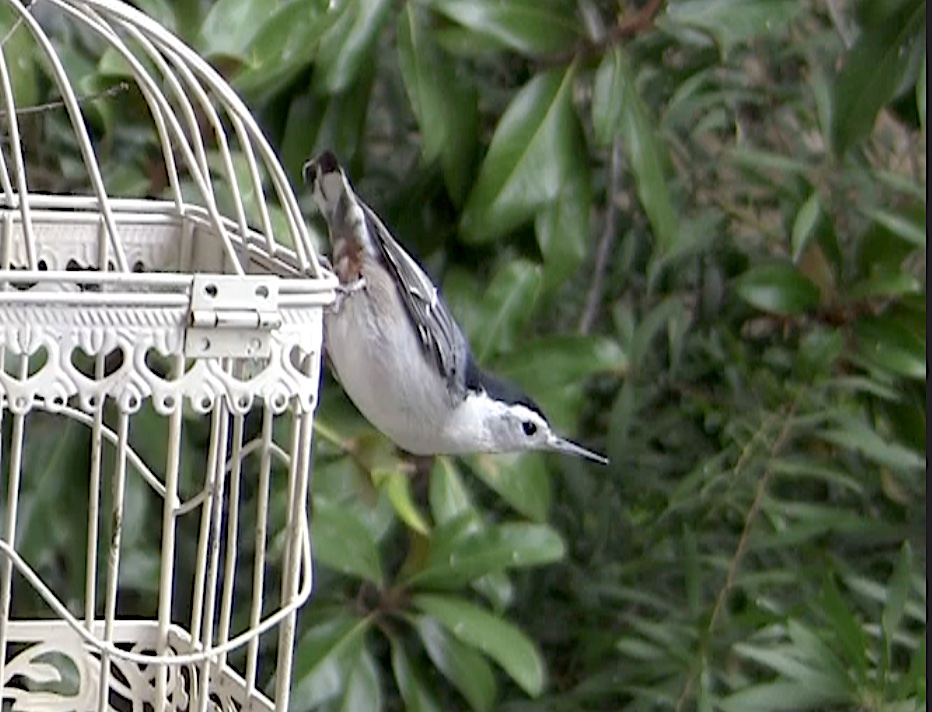
White-breasted nuthatch

White-breasted nuthatch perches on one of my bird cage birdfeeders

I don’t use commercial feeders; rather, homemade ones designed to be as delightful to look at as the birds that frequent them. Learn how to use feeders wisely, encourage repeat visits, and spot adorable fledglings. You’ll hear bird sounds, see fascinating footage, and discover how to identify mystery birds (even from blurry phone photos).

Uncommon Lives of Common Birds

Among the easiest to attract are finches. House finches and goldfinches are found throughout North America. Orioles also are eager feeders, and their annual arrival is a much anticipated event.
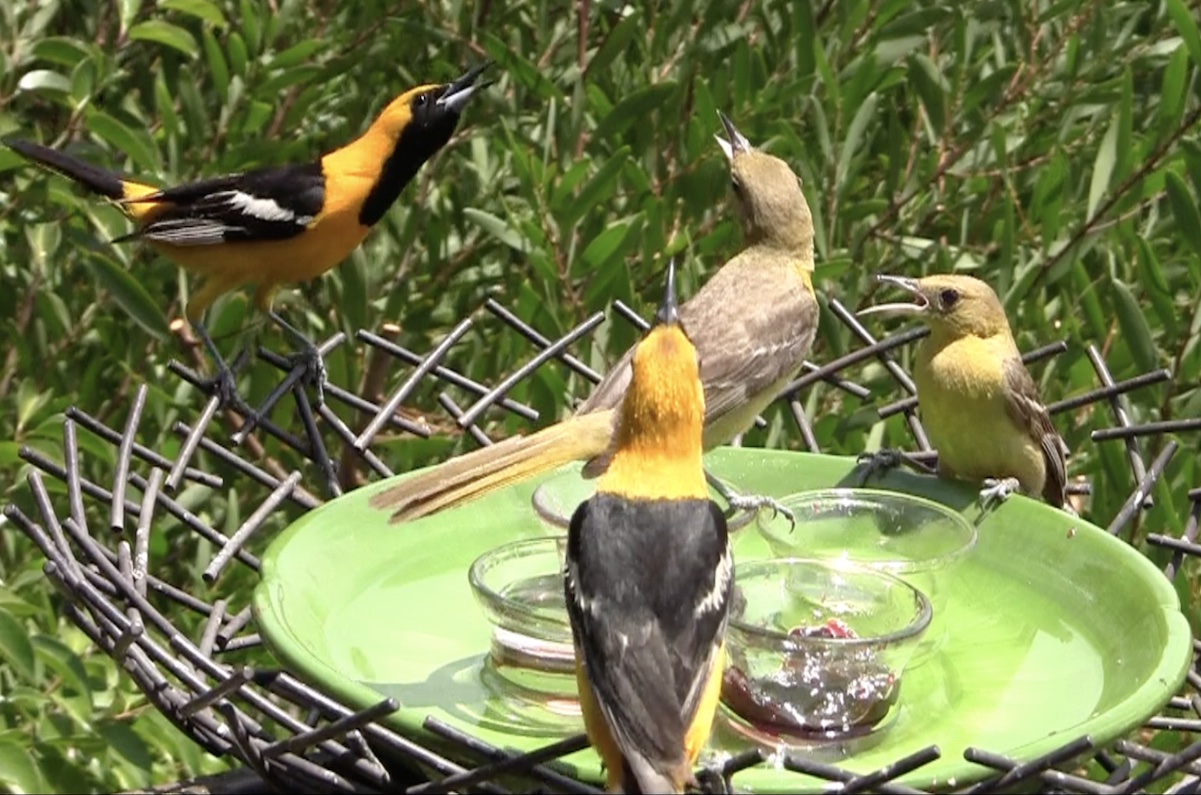
Hooded orioles at feeder in summer, Southern CA (c) Debra Lee Baldwin

Hooded orioles migrate from Mexico and nest in fan palms. They have two broods during the summer. Paler ones are juveniles.

Once wild birds start coming to your feeders, they’ll bring their offspring. Baby birds (fledglings) are a delight. As they shadow their parents, they're clumsy, wide-eyed, and adorable.
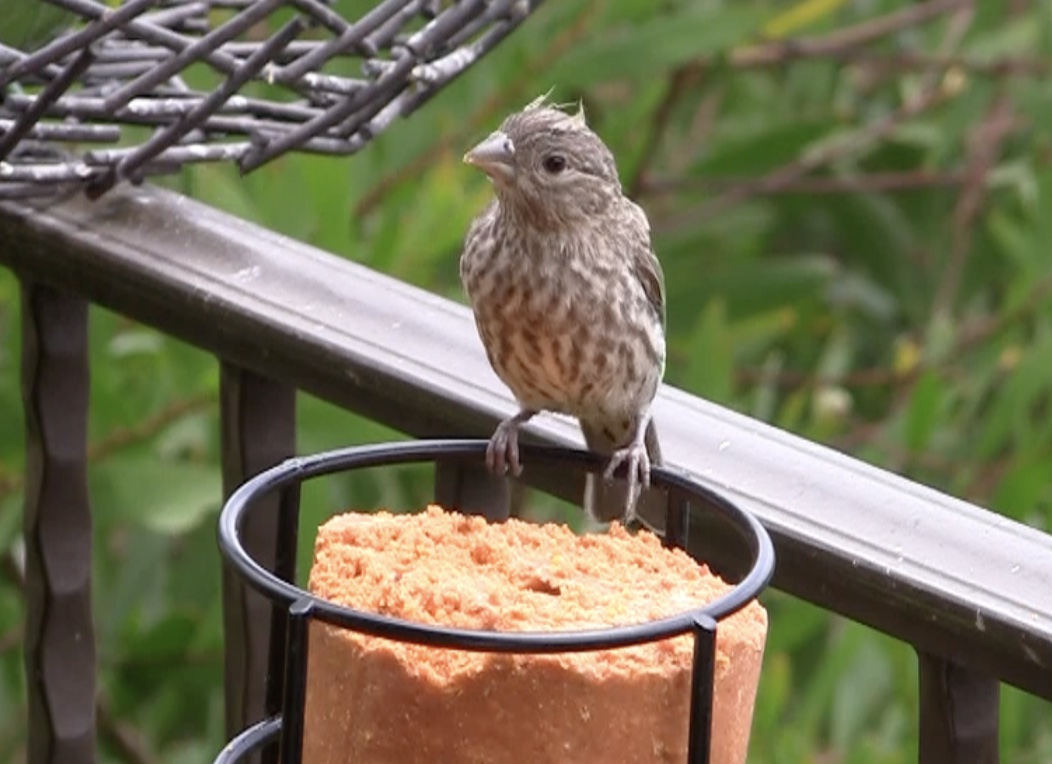
Fledgling house finch on suet feeder (c) Debra Lee Baldwin

Fledgling house finch on suet feeder. Wispy feathers above its eyes indicate it recently left the nest.

Feeders vs. Flowers

I no longer bother with hummingbird feeders—which I found to be messy, sticky, ant-attractors. If not kept impeccably clean, they can spread fungal diseases that make birds sick.

I prefer to grow tubular flowers that attract hummers, like aloes and echeverias. Plant them so they’re visible from your windows, and enjoy watching hummers visit daily, year-round.
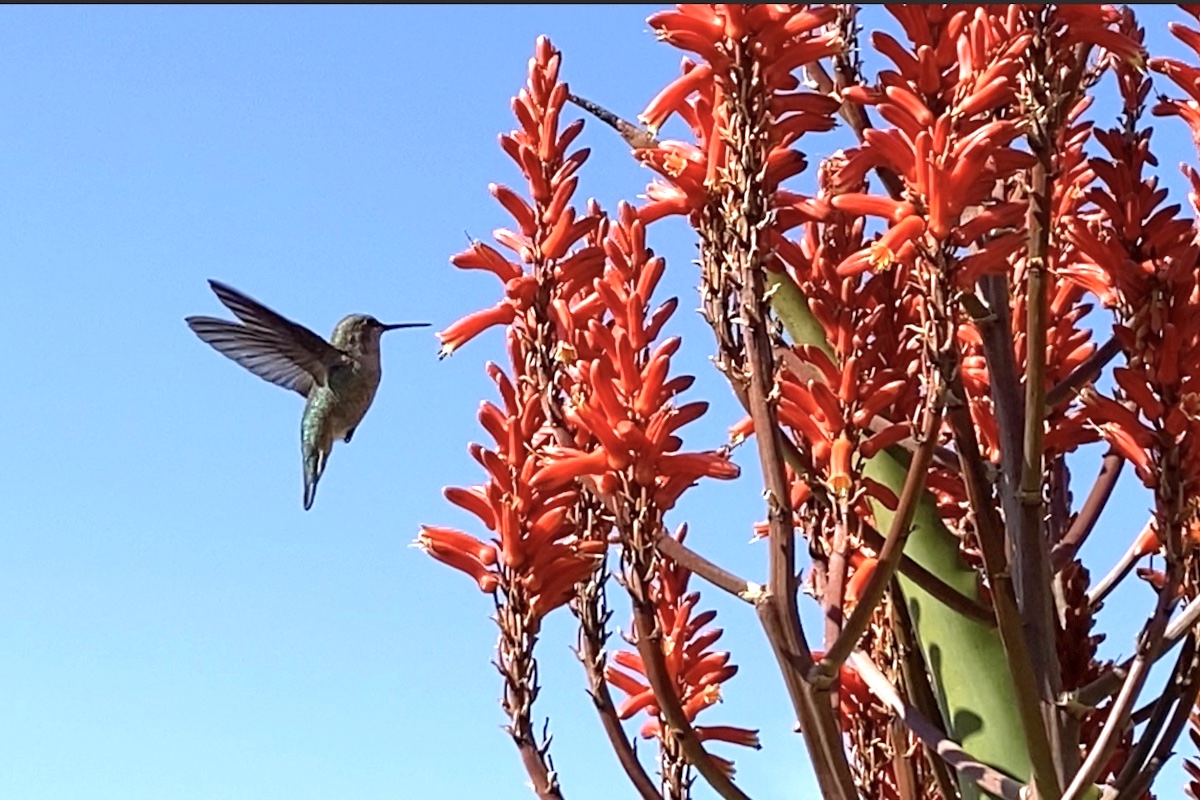
Male Anna's hummingbird gathering nectar from Aloe vaombe, Vista, CA (c) Debra Lee Baldwin

A male Anna's hummingbird gathers nectar from Aloe vaombe.

In my opinion (I have "the Sunset aesthetic"), commercial bird feeders are eyesores. Plus they tend to be expensive and hard to clean. Not to mention it's so easy to make your own!
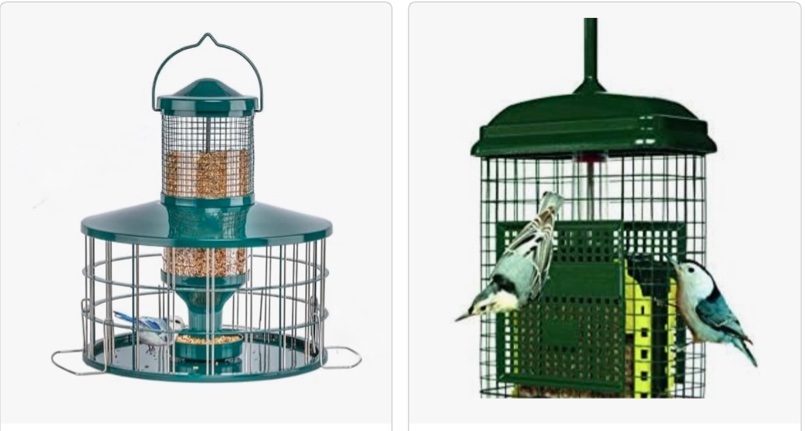
Commercial bird feeders look like prisons (c) Debra Lee Baldwin

Commercial feeders, two of many examples

All you need are something that hold bird seeds, and hooks and chains for hanging it. Compare the commercial feeders above to those below, which I made using ceramic flower pots by a local artist. Each holds a saucer of birdseed. To catch the morning sun, I added prisms.
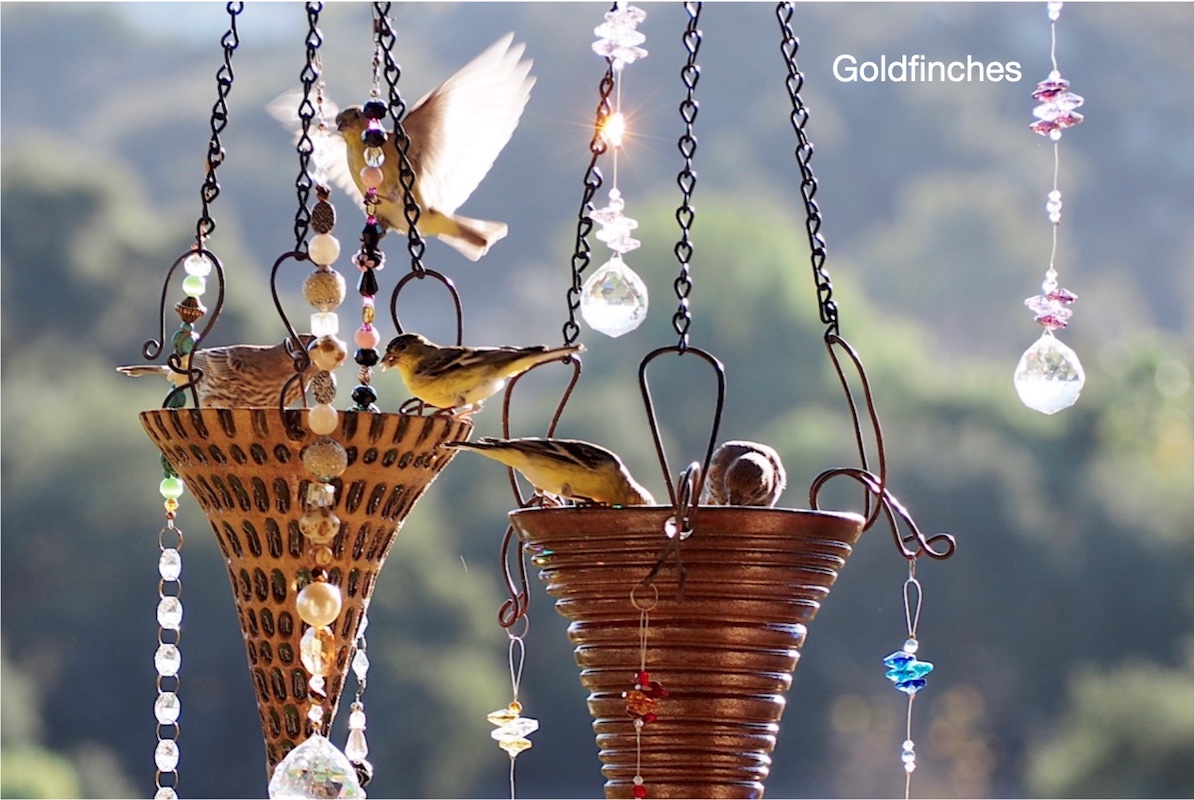
Lesser goldfinches and prisms lit by morning sun. (c) Debra Lee Baldwin

On my east-facing deck, finches and prisms sparkle in morning sun.

Creative Bird Feeders

After experimenting with repurposed objects for feeders for several years, I've decided that ornamental bird cages—with space for glass votive cups to hold seed, suet, or jelly—are ideal. Wires spaced about an inch apart let in finches and other small birds while keeping larger birds out.
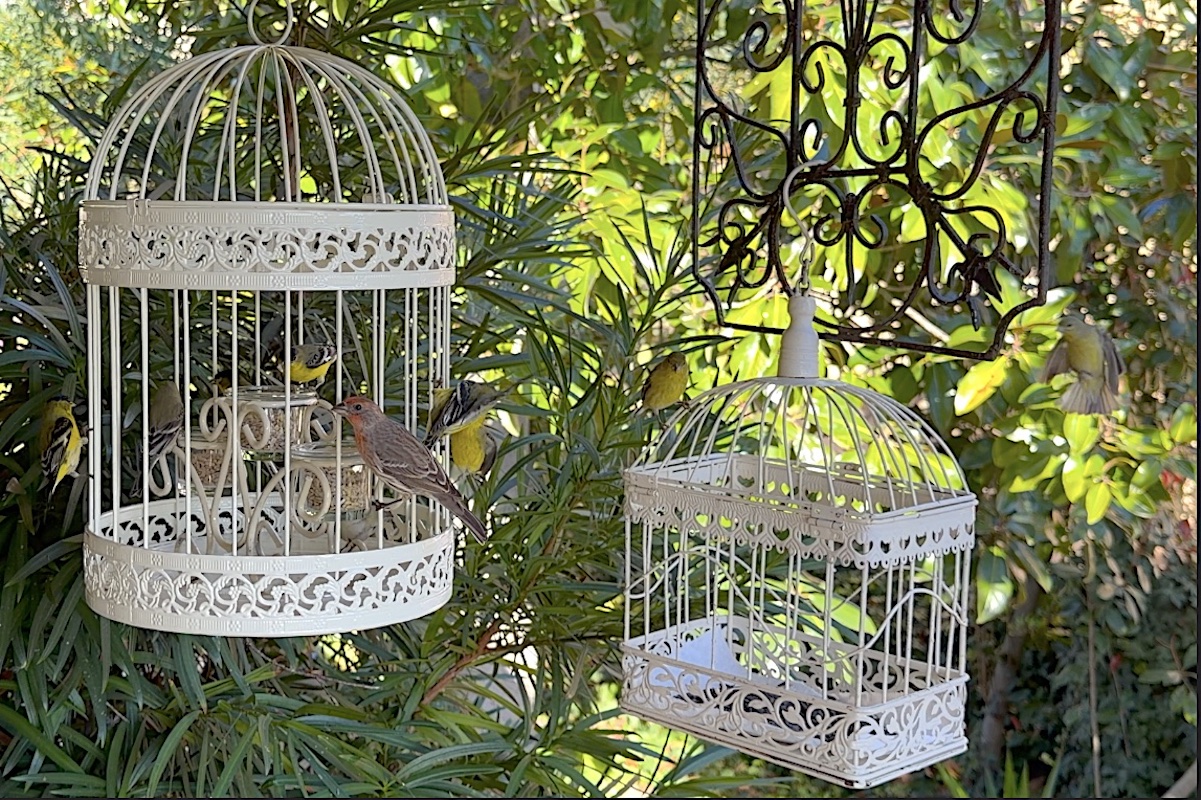
Bird feeders I made with ornamental bird cages (c) Debra Lee Baldwin

Birdcage bird feeders hang from eaves, just off the deck outside my kitchen window. On Amazon: Bird-cage birdfeeder, 10” diameter x 16.5” tall, https://amzn.to/45FXG9b affiliate link.

The feeder on the left has shelled raw sunflower seeds in glass votive cups. I elevated the cups for better viewing in a thrift store candleholder that I spray-painted white. The one on the right has black sunflower seeds in the shell, which titmice prefer.

People who visit are intrigued when they see wild birds voluntarily enter and exit cages. It never gets old!

Smart Birds

Scrub jays are especially persistent—yes they’re beautiful, but also bold and smart. I tried deterring one from eating other birds' favorite food* with a hose, but it simply shook off the water.

*Hot pepper suet cylinder from Wild Birds Unlimited. See Resource List below.

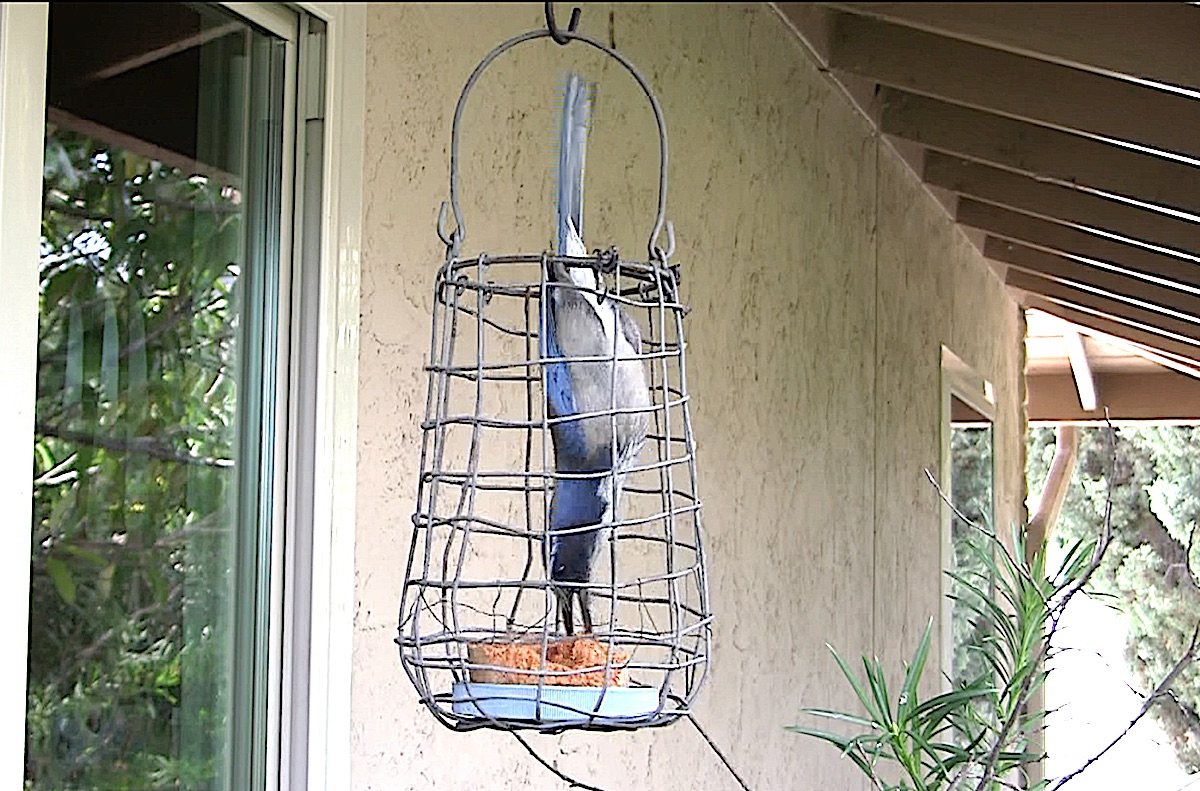
Scrub jay feeding upside down (c) Debra Lee Baldwin

A determined scrub jay solves the Puzzle Feeder.

That inspired me to see how long it would take jays and other birds to get to food, if I made it more challenging for them. So I created a Bird Puzzle Feeder with suet and raw peanuts in a barrel-shaped wire basket.
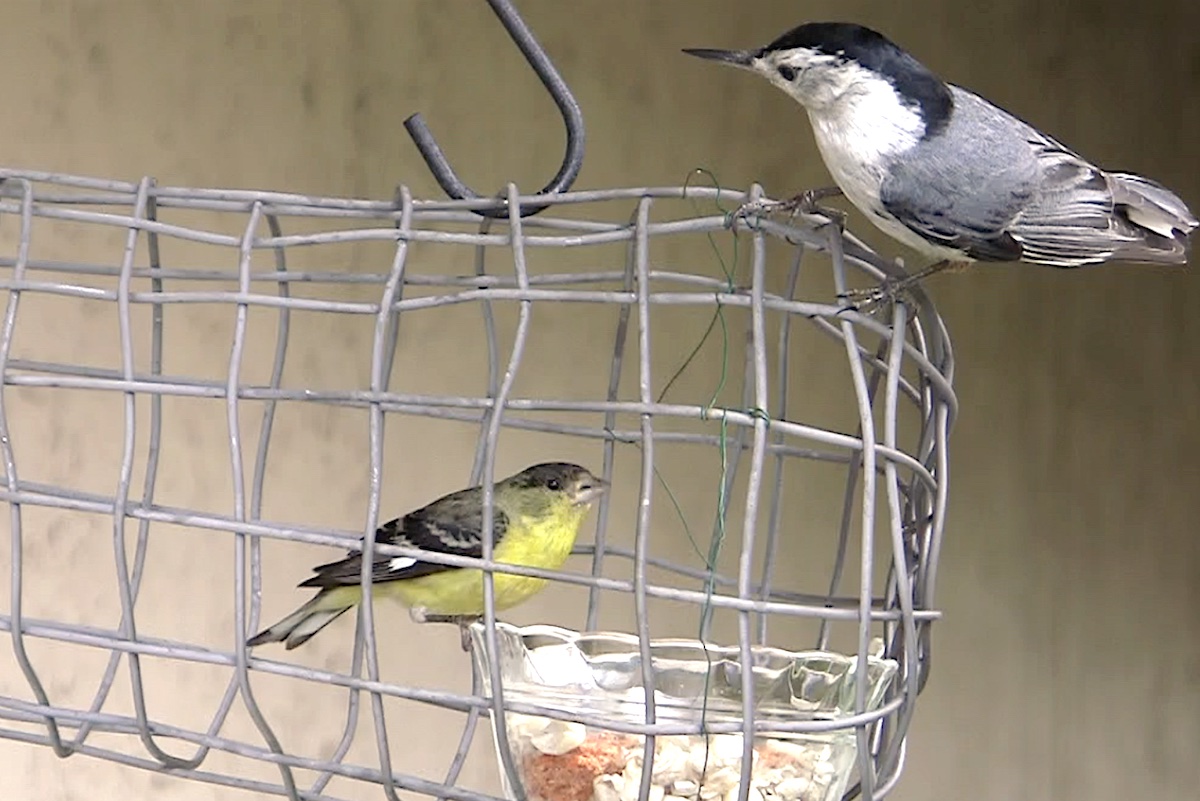
Nuthatch and goldfinch at feeder (c) Debra Lee Baldwin

Nuthatch and goldfinch at the Puzzle Feeder

Finches and titmice solved the puzzle fairly easily, orioles took a little longer, and a sweet little nuthatch was the slowest, but finally figured it out.

Seasonal Changes

Top photo: During a rainstorm, a flock of lesser goldfinches took shelter under my home’s eves, next to a birdcage bird feeder. Those with black caps are males.

Nesting begins in late winter, so it's helpful to supply materials like coir (coconut fiber). You may have noticed birds will take  it anyway if you have plants in fiber-lined hanging baskets.
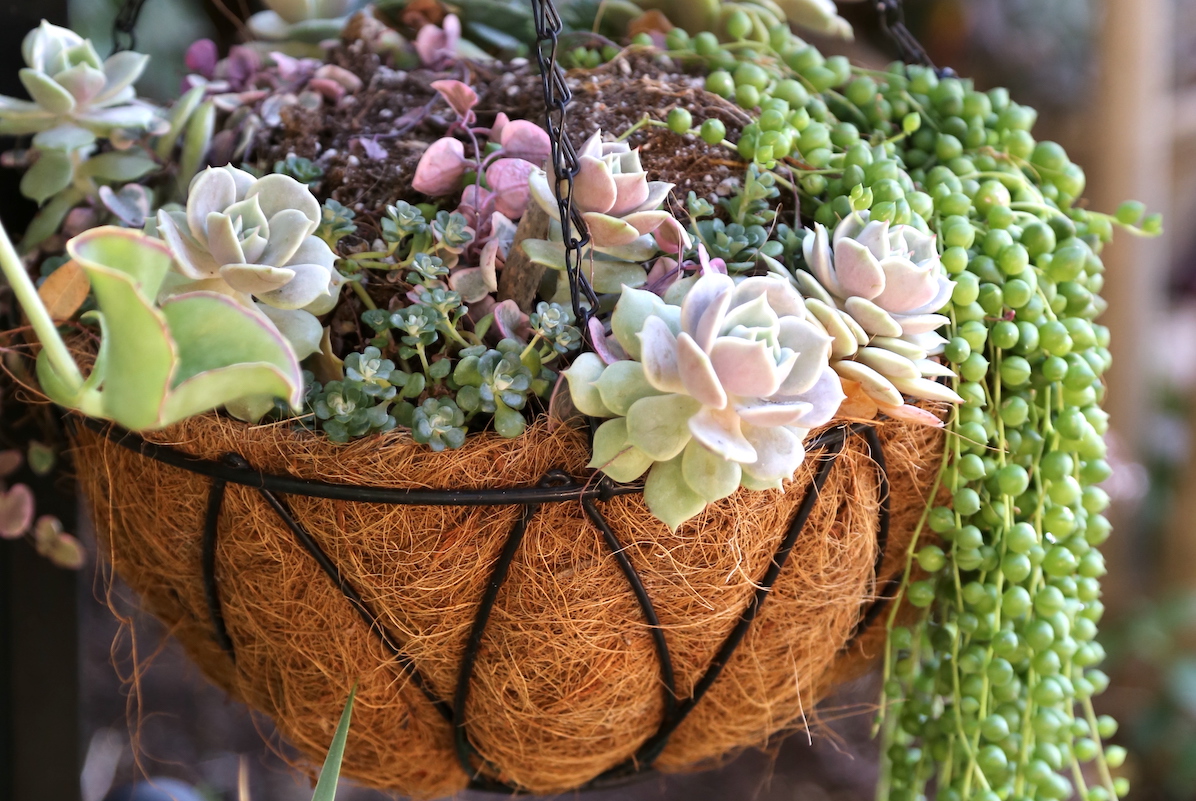
Hanging basket of succulents with coir liner (c) Debra Lee Baldwin

Hanging basket of succulents with coconut fiber liner

From spring into summer watch for fledglings, which peak in May and June. Although adult-sized, they're easy to spot because they cheep incessantly at their parents, which they hotly pursue.
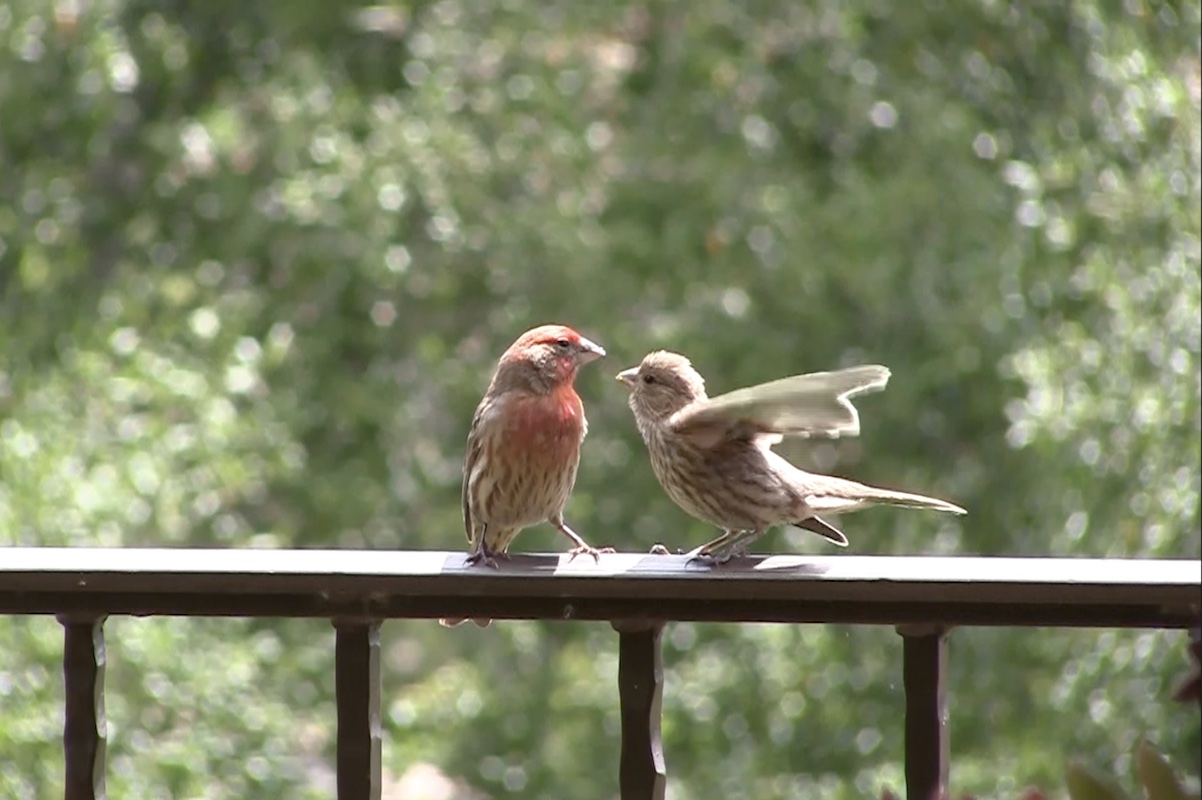
Fledgling house finch begging from male parent (c) Debra Lee Baldwin

Fledgling house finch begs its father for food

Mom and dad show fledglings how to use the feeder, but the babies flutter, cheep, and gape for food regardless. Parents literally shrug their shoulders and give in, but not in resignation---rather, regurgitation.

Shorter days and colder temps bring white-crowned sparrows. They’re ground-feeders that clean up fallen seeds, as do quail, doves and wrens.

Enjoy "Your" Birds

It’s counterintuitive, but a birdwatcher needn't be quiet. Birds don’t pay much attention to noise. However, they'll scatter at even the slightest movement. After all, their biggest fear is being snatched by a silent predator—a hawk or cat.

A smart birdwatcher knows how to freeze in place or sit still until she's no longer considered a threat. That takes five or ten minutes, but then magic happens. Even though you think you’ve seen everything, you may notice---as I did recently---the unprecedented: a flock of munias at my fountain.
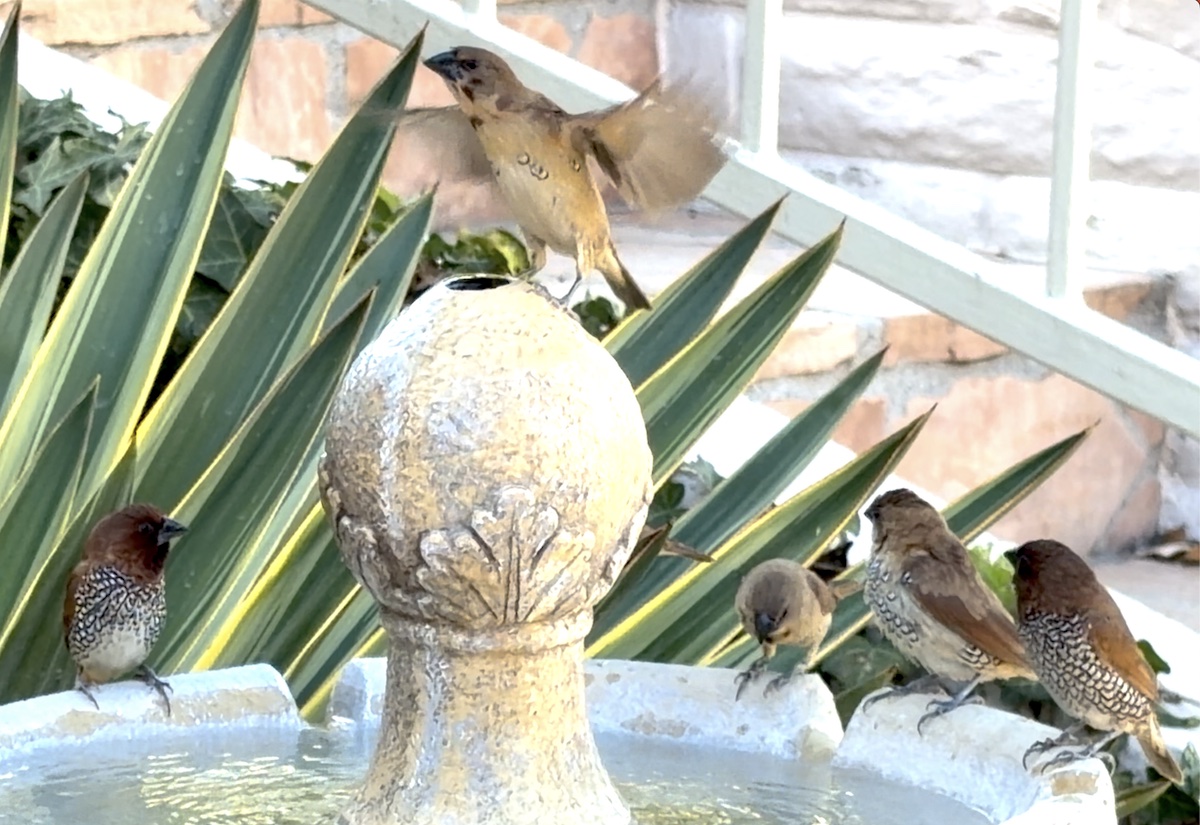
Scaly-brested munia flock at a fountain in Escondido, CA (c) Debra Lee Baldwin

Scaly-breasted munias, originally from Southeast Asia, have naturalized in parts of California. They prefer being near water.

Discourage nocturnal pests like mice and rats with metal cones around access points such as tree trunks, table legs, or patio supports. Feed birds early in the day and if possible, bring feeders in at night. I clean and fill mine so they’re ready to go outside the next morning.

Here in inland San Diego county, tree squirrels---the bane of bird-feeding enthusiasts---have yet to be a problem. But before you envy me, consider: We do have ground squirrels. These cute pests undermine our stone steps, terraces, embankments, and--even as I write this---are probably eyeing my home's foundation.

Cleanliness and Safety

While bird droppings may not bother you any more than a diaper pail once did, guests may find them gross. Once or twice a week, and right before company comes, I soften droppings with a hose, then blast them away. I spot-clean floors, perches and railings with damp paper towels.

As for the feeders outside my kitchen window, droppings and seed husks disappear into ivy below. Which reminds me: If you set mouse traps, check them at dawn to avoid accidentally killing ground-feeding birds. (Yes, that happened once, and to this day I feel awful about it.)

Birds Love Water

Birds appreciate a water source---a birdbath or fountain that provides water for drinking and bathing. Most find dripping or bubbling water irresistible. Water also attracts species that don’t frequent feeders, such as woodpeckers, robins, and bluebirds. We even had a raven visit.

Don’t waste your money on Frisbee-sized solar-powered floating fountains for birdbaths. They need to be in full sun to work, and birds won't go to an exposed birdbath. Birds avoid being vulnerable, especially when wet (which makes it harder to fly fast). The water sources they prefer are near trees and shrubs.

Scrub jays perched on garden fountain (c) Debra Lee Baldwin

Scrub jays perch on my garden fountain. On Amazon for about $130 https://amzn.to/4654JZ2

Bird House Placement and Nesting Preferences

Nesting birds are territorial and want their own air space, so I don’t place birdhouses near feeders. The elevation of the box and its entry hole size matter; every species has its own requirements. Holes that are too large---typical of ornamental bird houses---can allow predators like crows to grab hatchlings.
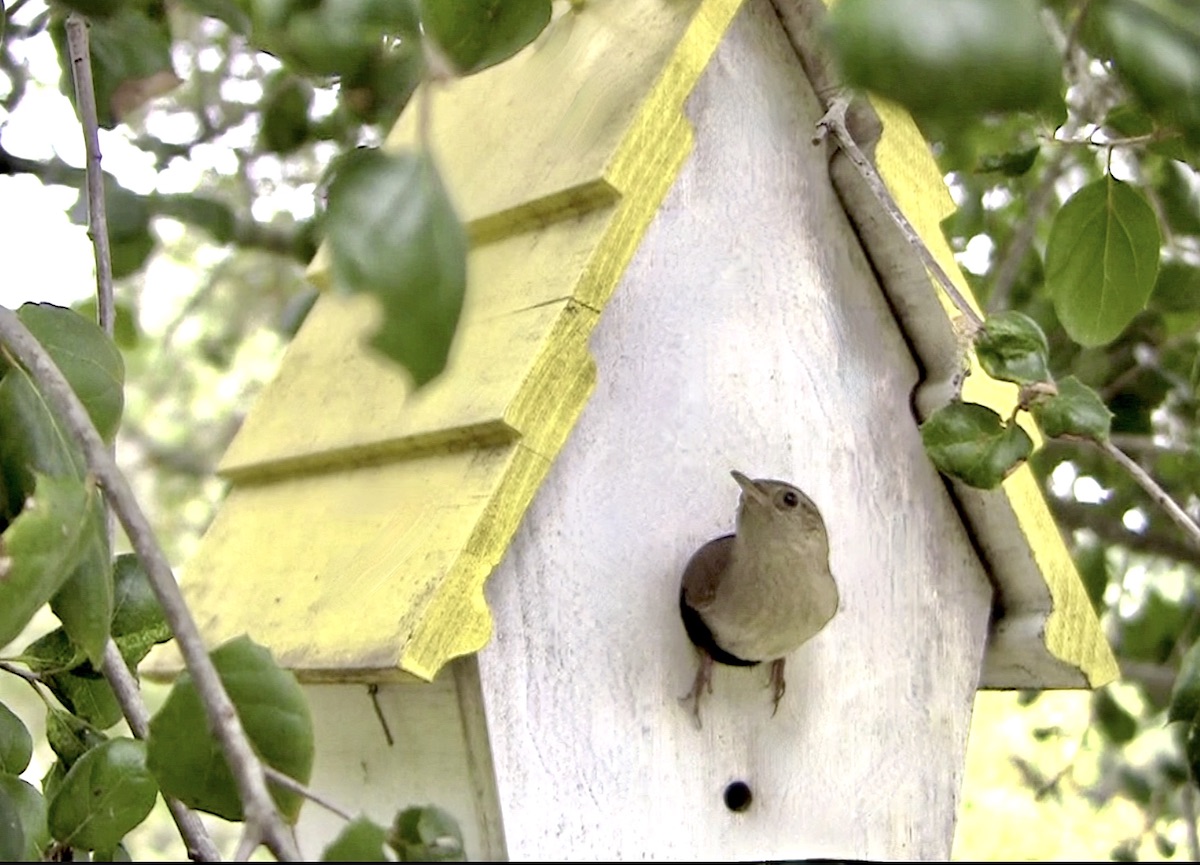
Bewick's wren leaving birdhouse (c) Debra Lee Baldwin

Bewick's wren leaving birdhouse

Doves will nest in hanging baskets or amid tangled tree branches, as do jays. Orioles use fibers from palm fronds to weave hanging nests in tall palm trees.

I purchased a nesting box for bluebirds, but despite their fondness for my fountain, they’ve yet to use it. Titmice nested in the box for a few years but now prefer a hole in my coast live oak. Wrens also are cavity nesters that will use bird boxes. House wrens, thankfully rare in this area, will evict Bewick’s wrens, fledglings and all. Not nice.

Urban proximity increases the likelihood of attracting bullies such as starlings, grackles, blackbirds, and crows. I’ve not had issues with those, so I can't advise how to discourage them.

I do know that smart birds like corvids (jays and crows) are a mixed blessing. They're amazing in their own way, and are trainable. Friends who hand-feed scrub jays are quite fond of "their" birds. And in another video in my YouTube bird series---the one about identifying fledglings---I tell the story of "Francesca" the crow, who became a friend, sort of, and proudly brought her fledglings.

Debra’s Backyard Bird-Feeding and -Watching Essentials

Before buying food or nesting boxes, find out what your avian visitors prefer. What works for one species may not for another.
Commercial seed mixes are convenient but typically contain cheap fillers like corn kernels and millet, which is why I buy only what each bird likes (see chart at end). 

Favorite Bird Books  

Sibley Birds West book

Sibley's is a must-have for IDing birds based on appearance, calls, season, and range.

Sibley Field Guide to Birds of Western North America, https://amzn.to/3McfUZg

Baby Birds: An Artist Looks into the Nest, by Julie Zickefoose, https://amzn.to/3ZrnYsd

What It’s Like to Be a Bird, From flying to nesting, eating and singing, by David Allen Sibley: https://amzn.to/4koSv3v

Sunset’s Illustrated Guide to Attracting Birds: Bird identification, plant lists, feeders, houses and baths https://amzn.to/4kmeN5P

Rare Encounters with Ordinary Birds, by Lyanda Lynn Haupt https://amzn.to/4bE2OhR, and other books by Haupt, including Urban Bestiary: Encountering the Everyday Wild; and Mozart’s Starling

Backyard Bird Chronicles, by Amy Tan https://amzn.to/4kocr6H

"My" Birds and What I Feed Them
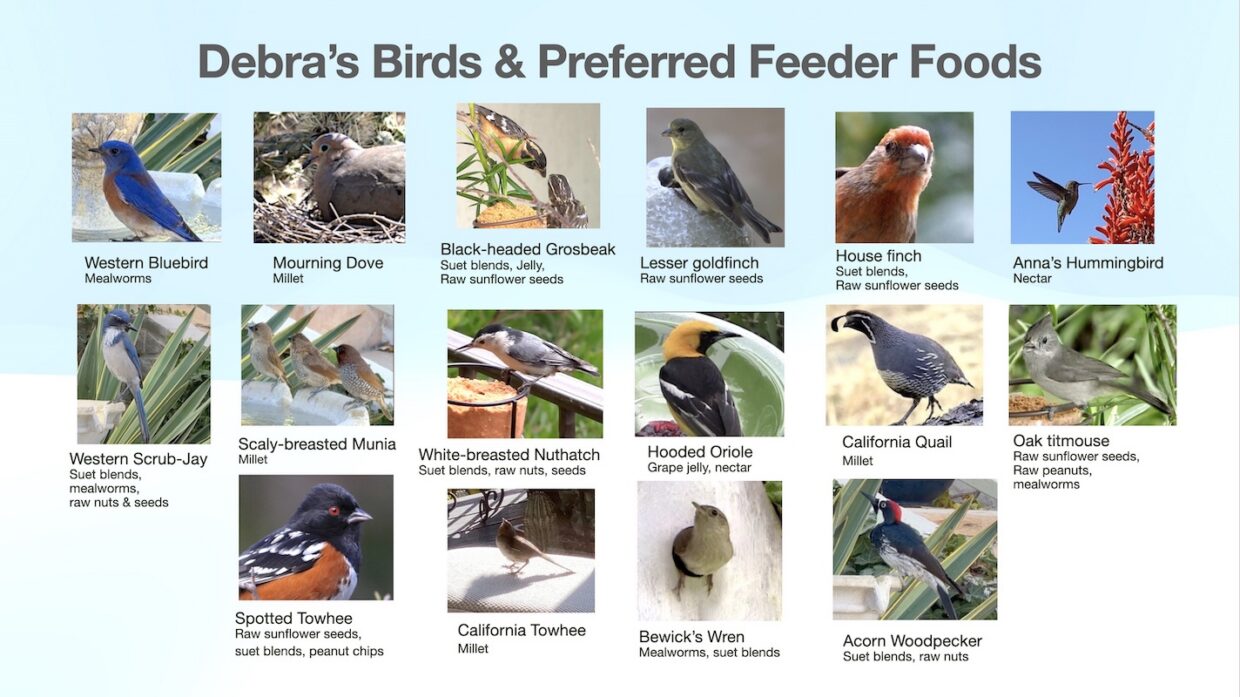
16 CA backyard birds, photos and preferred foods (c) Debra Lee Baldwin

16 CA backyard birds and what I feed them. 

For additional info and links to my YouTube bird videos, type "birds" in the search bar at https://debraleebaldwin.com. Or go to my YouTube channel's Birds playlist

Oriole feeding fledgling (Hooded)

See Baby Birds (Fledglings) at Feeders

Fledglings are toddlers of the bird world: cute, endearing and fun to watch. They’re awkward, curious, beg loudly, and don’t let their parents out of their sight. You’ll see nine different types of western birds shortly after they’ve left the nest. Look for these flying jewels in your own backyard. I show parents and offspring at unconventional feeders
The post How to Watch the Birds That Are Watching You appeared first on Debra Lee Baldwin. Copyright © Debra Lee Baldwin.


from Debra Lee Baldwin https://ift.tt/h9867l4
via IFTTT

jueves, 12 de febrero de 2026

DIY Succulent Driftwood Designs Amazing tips

DIY Succulent Driftwood Designs

Succulent driftwood design

When you make succulent driftwood designs, the plants resemble undersea flora, and the wood hints at something you'd see washed up on the beach. The two combine to make a special, almost fantasy-like composition that works well as a patio centerpiece or special gift for a friend.

Driftwood for succulent driftwood designs

Driftwood pieces (from Sea Foam Driftwood) come with pre-drilled crevices for potting.

Embellishments for succulent driftwood designs

Materials include cuttings or small, rooted plugs (tiny plants ready to be plugged into pots), sea shells, bits of tumbled glass, moss, rocks and sand. Tools are clippers, hot glue, and a chopstick for tucking-in plants and settling roots.

Succulent driftwood design, prep

Begin by filling the planting hole with potting soil.

Succulent driftwood design in process

Add small rooted succulents and cuttings, envisioning them as undersea flora and fauna growing in and on submerged logs.

Succulent driftwood design, how-to

Use a chopstick to tuck floral moss into remaining gaps. Moss will conceal any exposed soil and help hold cuttings in place until they root.
Succulent driftwood design with shell

Cuttings include trailers (Ruschia perfoliata, Crassula lycopodioides), colorful rosettes (Sedum nussbaumerianum and Graptosedum 'California Sunset'), and Crassula tetragona, among others. A sea urchin shell, attached with hot glue, is the perfect finishing touch.
Succulent driftwood design, completed

Here's a slightly different assortment: Crassula lycopodioides (watch-chain crassula), a dwarf aloe, Aeonium haworthii, Crassula perforata 'Variegata' (a stacked crassula), and for upright interest (at right), Hatiora salicornioides.

Succulent driftwood design, finished

Fill a piece of driftwood with pieces of jade, Kalanchoe pumila, variegated aeoniums, an echeveria, a dwarf aloe that resembles a sea star, and dainty cremnosedum rosettes. You might cluster smaller shells, too.

Succulent driftwood design

A long piece of driftwood, with several areas for planting, makes a good centerpiece for a rectangular outdoor table.

Succulent driftwood design with shells

Watch my YouTube video: Succulents in Driftwood (2:51)

See “Marine Life Look-Alikes” on page 101 of Designing with Succulents (2nd ed)

Related Info on This Site:

Clam shell planter

Seashell potting demo at Roger's Gardens


The post DIY Succulent Driftwood Designs appeared first on Debra Lee Baldwin. Copyright © Debra Lee Baldwin.


from Debra Lee Baldwin https://ift.tt/pfdHXz9
via IFTTT

jueves, 8 de enero de 2026

Must-Do’s for Rain-Soaked Succulents Amazing tips

Succulents from South Africa and Madagascar (such as aloes, jade and kalanchoes) thrive along the California coast because the climate and weather patterns are similar to those of their native habitats.

The farther you go inland, like my own garden---at 1500 feet in the foothills NE of San Diego---it gets too cold in the winter and too hot in the summer for many soft succulents (as opposed to agaves and cacti).

If I can do it, so can you

Yet without difficulty, I grow hundreds of species---nearly all those I show throughout this site and in my three books on succulents. How? Basically I understand my terraced half-acre's microclimates and position plants accordingly. (And I have a few other tricks up my sleeve.)

Even closer to the coast, you'll contend with changing weather patterns that provide less or more rain than these water-storing plants need.

The info on this page will help you get your chubbies through rainstorms without rotting. Here too are essentials about drainage, frost and hail.

The video above is one of several I've made about winter weather and succulents. Scroll down for additional videos you'll find helpful. 

After rainstorms, check for:

-- Succulents with rotted leaves. Remove mushy leaves before rot spreads to the plant's stem or crown. 

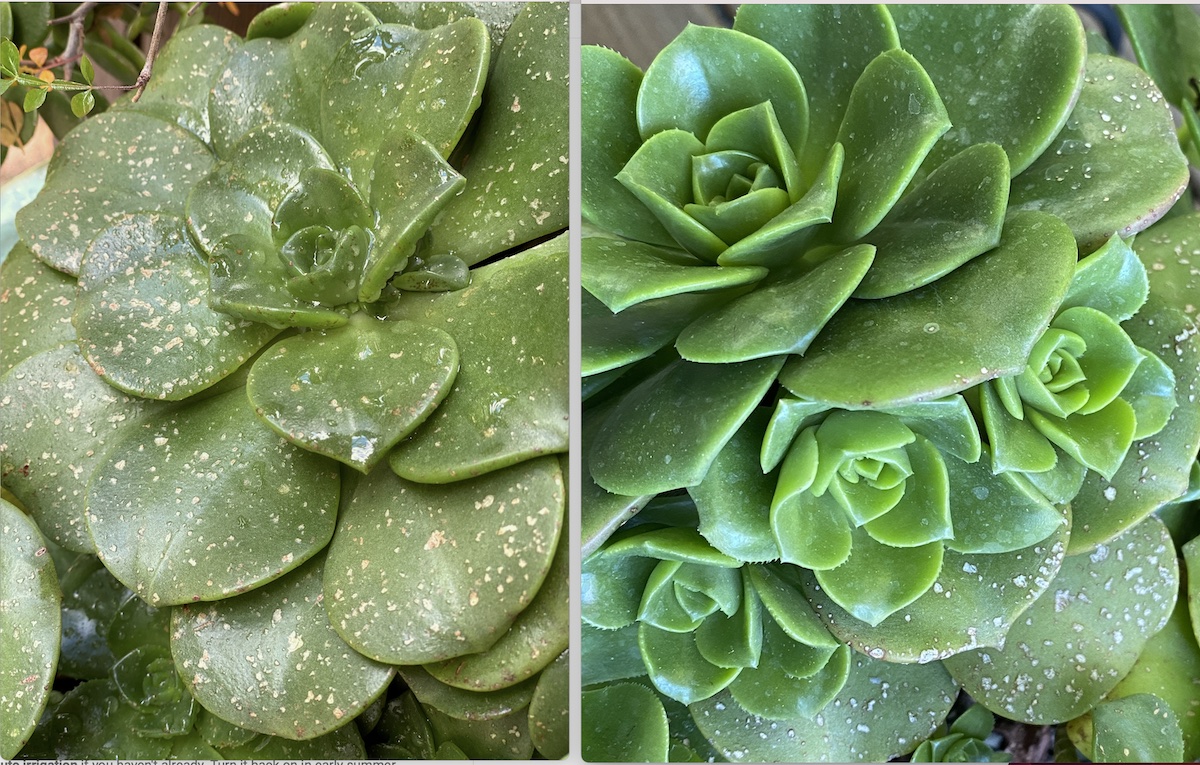
Hail damage on succulent, and six months later (c) Debra Lee Baldwin

Hail damage when it happened in January and after six months of growth, in July.

-- Hail damage. White dots from the impact of tiny bits of ice appear on upper leaves. New growth usually covers them.

-- Drainage issues. If soil stays sodden and muddy areas remain long after a storm, roots may drown. Move plants to higher ground. Install French drains.

-- Slope erosion. Create dams of rocks and diversion channels, and top-dress the soil with gravel or mulch to diffuse the rain's impact. Soil shifted by erosion can bury trunks and cause rot.

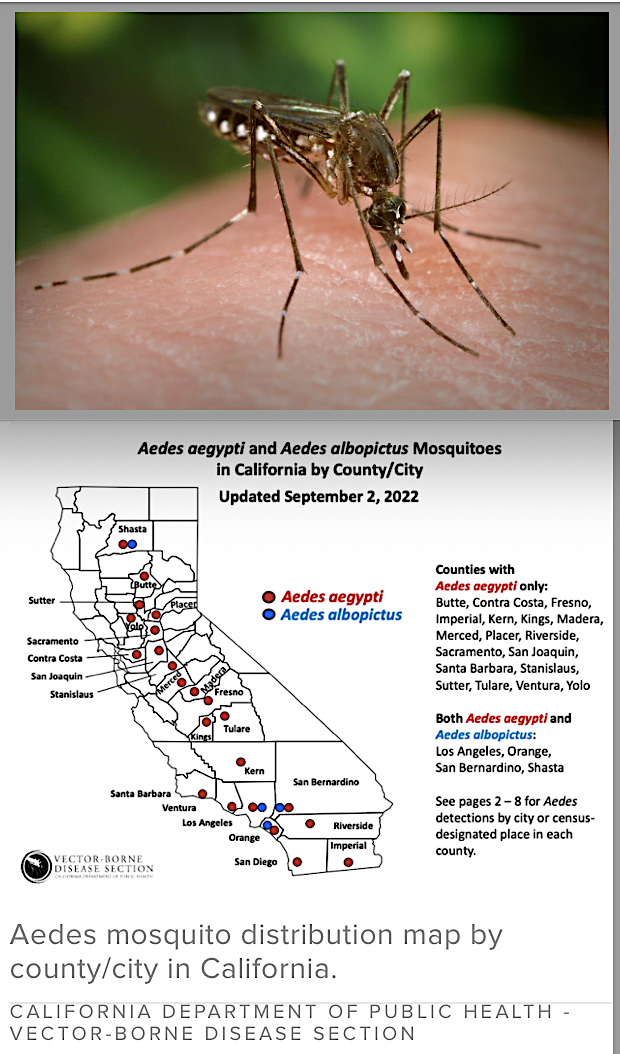
-- Stagnant water. Check pots, bins and barrels. If they've filled, dump the water before mosquitos find it and breed.

Egyptian mosquito (c) CA Dept. of Public Health
Above: New from Pandora's box is a mosquito from Egypt that's smaller and more aggressive than our regulars. I wear thick socks and long pants because I'm mosquito candy and these flying needles hover near the ground. 

-- Weeds. Wherever soil is exposed to sun, weeds WILL sprout. Get them when small. All too soon they'll have deep roots, go to seed, and look you in the eye.

-- Seepage. Check your home’s basement. Mine used to have an inch or two of standing water whenever the ground became saturated during storms. A few years ago, a friend suggested a simple solution: Coat the concrete blocks that form the basement’s walls with a special paint that prevents seepage. Works great. Any home improvement store carries it.

-- Shop for plants. Now’s a good time to accumulate plants you want to add to your garden. Rain-soaked ground is soft and easy to dig. Early spring is the best time to establish new plants, after all danger of frost has passed (here in Southern CA, mid-March). Plants will take off in spring and won’t have to contend with summer heat while putting down roots. Don't delay; if your garden is like mine, when the soil dries, it becomes hard as concrete.

-- Take photos as what-to-do reminders. When the weather clears, such issues are easy to forget.

-- Turn off your auto irrigation if you haven't already. Turn it back on in early summer or after a prolonged dry spell.

The good news: Succulents tend to be opportunistic when it comes to rain. Given adequate drainage and frost protection, they love it!

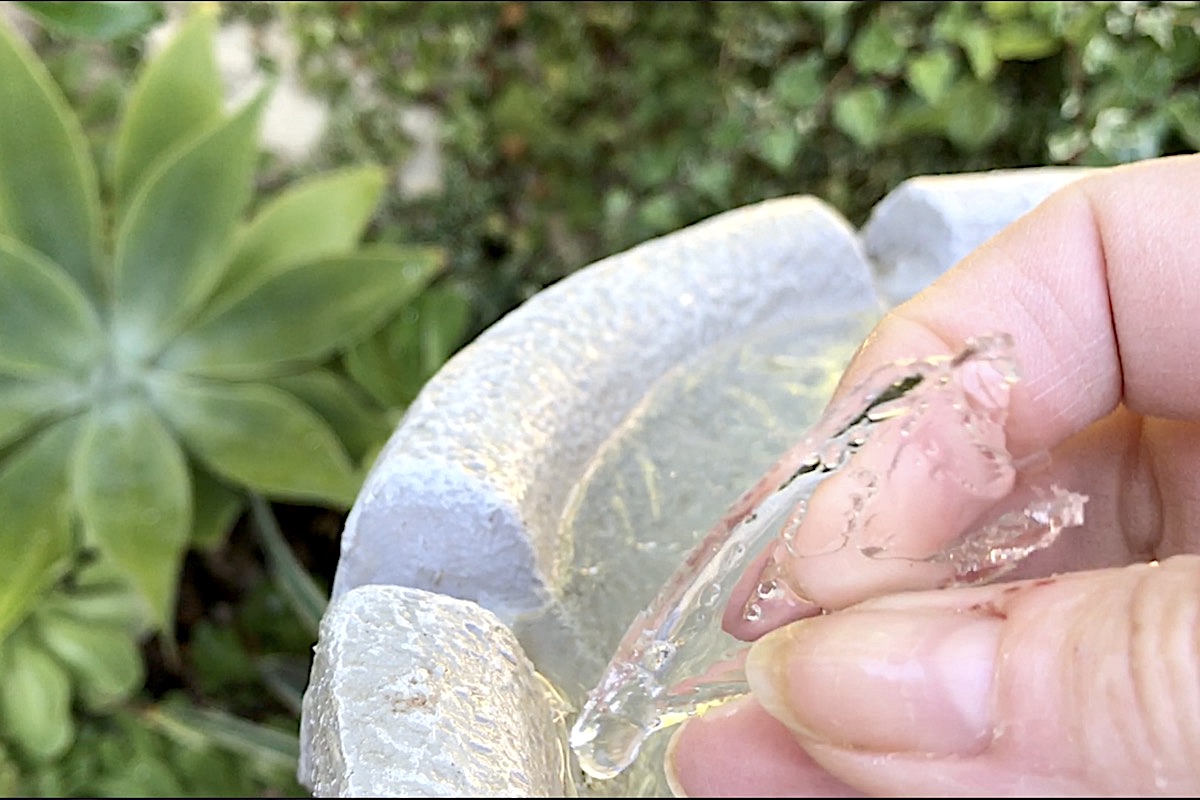
Ice in succulent garden (c) Debra Lee Baldwin

Ice in fountain. Temps tend to drop when nighttime skies are clear after a after winter storm

When Frost Follows

Frost may settle in low-lying areas on cold, clear nights after a storm. If temps are forecast to drop into the low 30sF, cover vulnerable non-native succulents (aloes, aeoniums, crassulas, kalanchoes, euphorbias) with bedsheets.

Better yet, use a lightweight, non-woven fabric ("frost cloth," "floating row cover"). Keep in mind succulents open to the sky are more vulnerable than those along walls or beneath eaves and trees.

Related VIDEOS

In these videos you'll see how I cope with less-than-ideal winter weather in my Zone 9b garden, and how I evaluate and contend with its impact on my succulents.

Why Succulents Rot and How to Prevent It

Sodden roots fall prey to bacteria and fungus that move upward into the body of the succulent, causing its tissue to soften collapse. Here's what to look for, and what to do.

The Squish Test for Succulents

Worried your succulents are getting too much water? Here's how I test and rescue succulents after rainstorms. Even if soft and squishy means rot, it's not always too late.

Post-Rain Must-Do's for Succulent Gardens

Have you checked your succulent garden after the rainstorms? I found a few things that needed taking care of and I bet you will, too!

Protect Your Succulents from Frost

Follow me through my own garden as I select and protect cold-sensitive succulents.

MORE Info on This Site

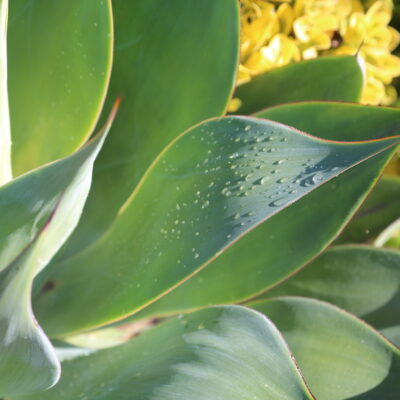
Rain on agave (c) Debra Lee Baldwin

How Rain Benefits Succulents

Here’s how rain benefits succulents: It provides dissolved minerals and washes away dust that inhibits photosynthesis; it dilutes and flushes salts and harmful chemicals that have built up in the soil from tap water; and it provides nitrogen essential to growth,

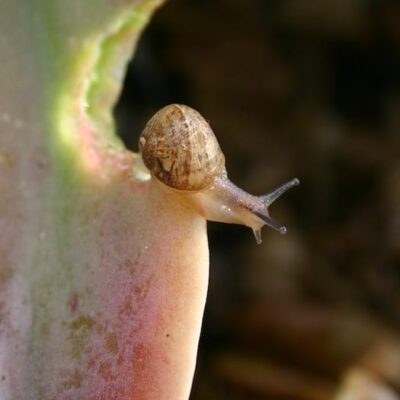
Snail on Succulent

Prepare Your Succulents for Rainstorms

During rainy weather, succulents, which come from arid climates, may rot. Stems or trunks turn squishy and collapse. It may be possible to take cuttings from healthy top growth and restart the plants—as I did after one rainy winter with aeoniums. Fortunately, the rest of my succulents came through fine, despite double normal rainfall. After…

Succulents and Too Much Rain, A French Solution

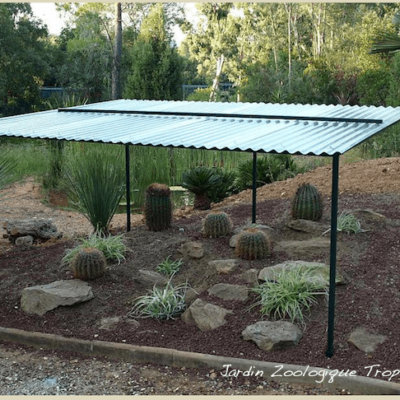
Want to protect your succulents from too much rain? Here’s how the Jardin Zoologique Tropical in southeastern France keeps their succulents from becoming waterlogged during seasonal rainstorms. Corrugated fiberglass panels atop metal bars tent the plants so excess rain doesn’t soak the soil. The structures are tall enough to allow good air circulation, and the panels are translucent, enabling maximum sunlight to reach the plants. The…

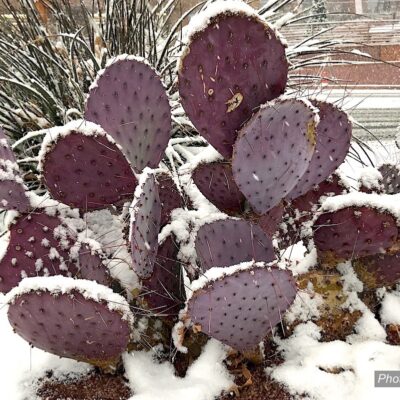
Purple cactus in snow

Winter Care for Frost-Tender Succulents

Depending on where you live, here’s how to get frost-tender South African succulents—like crassulas (jades), euphorbias, senecios and aloes—through a North American winter.

The post Must-Do’s for Rain-Soaked Succulents appeared first on Debra Lee Baldwin. Copyright © Debra Lee Baldwin.


from Debra Lee Baldwin https://ift.tt/Tc9VDzH
via IFTTT

miércoles, 22 de octubre de 2025

Secrets to Healthy, Happy Fat Plants (Pachyforms) Amazing tips

In my latest video, renowned succulent expert Julian Duval shares his secrets to keeping fat-trunked, potted succulents healthy and happy for decades. Such stout-stemmed succulents are pachyforms ---a term that includes pachycauls and caudiciforms. Julian, a lifelong plant enthusiast, is former CEO of the San Diego Botanic Garden.

This video is a sequel to my previous tour of Julian's Vista, CA garden, which encompasses several acres of rare tropicals and succulents large and small.

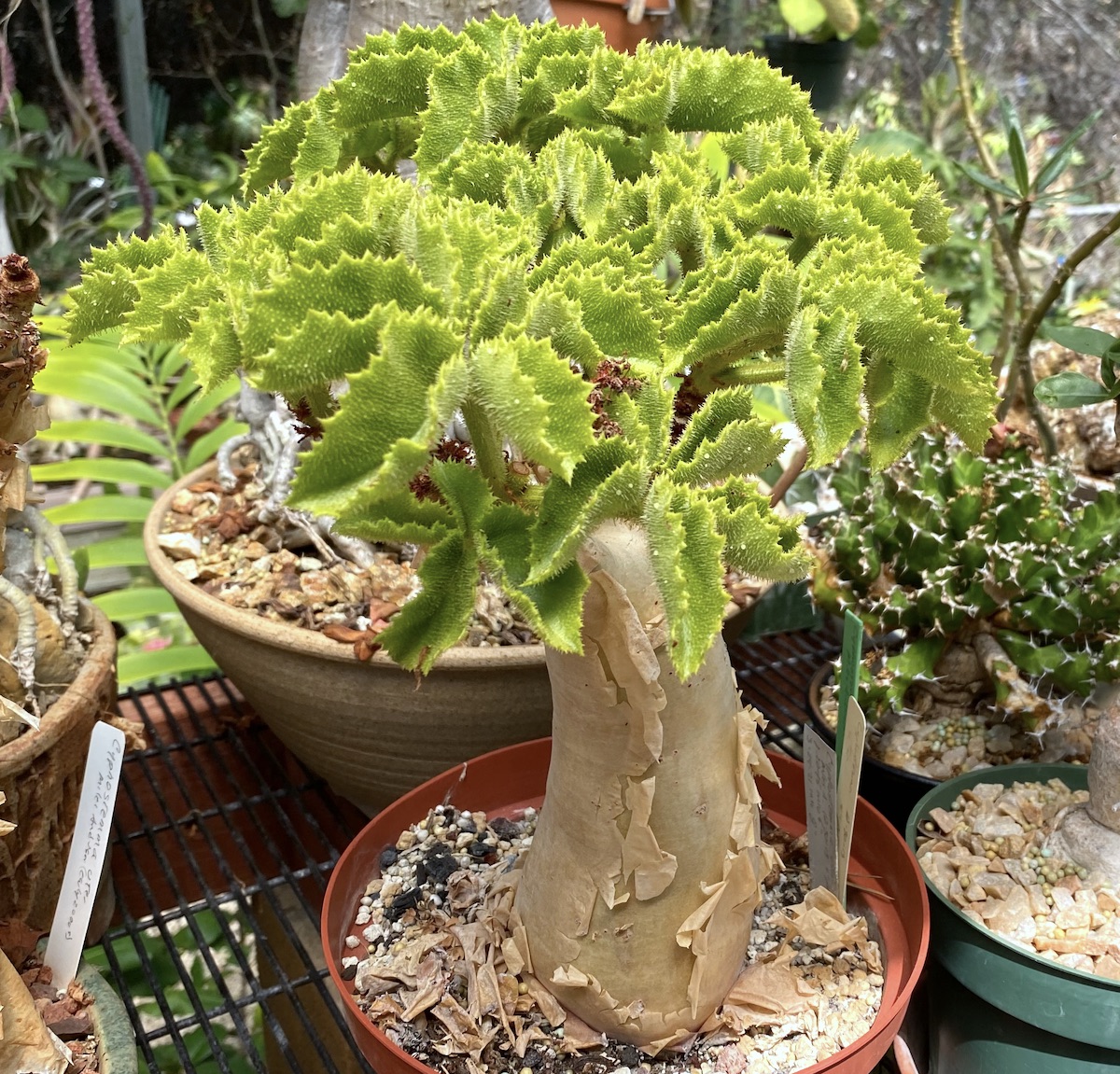
Succulent with bottle-shaped trunk and peeling, paper-like beige skin topped with clusters of bright green tapered leaves Cyphostemma uter (c) Debra Lee Baldwin

Cyphostemma uter, acquired 1989. 

Many of Julian's bonsai'd pachyforms are decades old.

In the video I give the country of origin for each fat plant. It's fascinating to know which are right next door (Mexico) and which are from, say, South Africa or the Arabian Peninsula.

The "tincture of time"

When asked how his fat-stemmed rarities earn ribbons at Cactus and Succulent Shows, Julian says, "It's the tincture of time. If you keep a plant long enough, it turns into something."

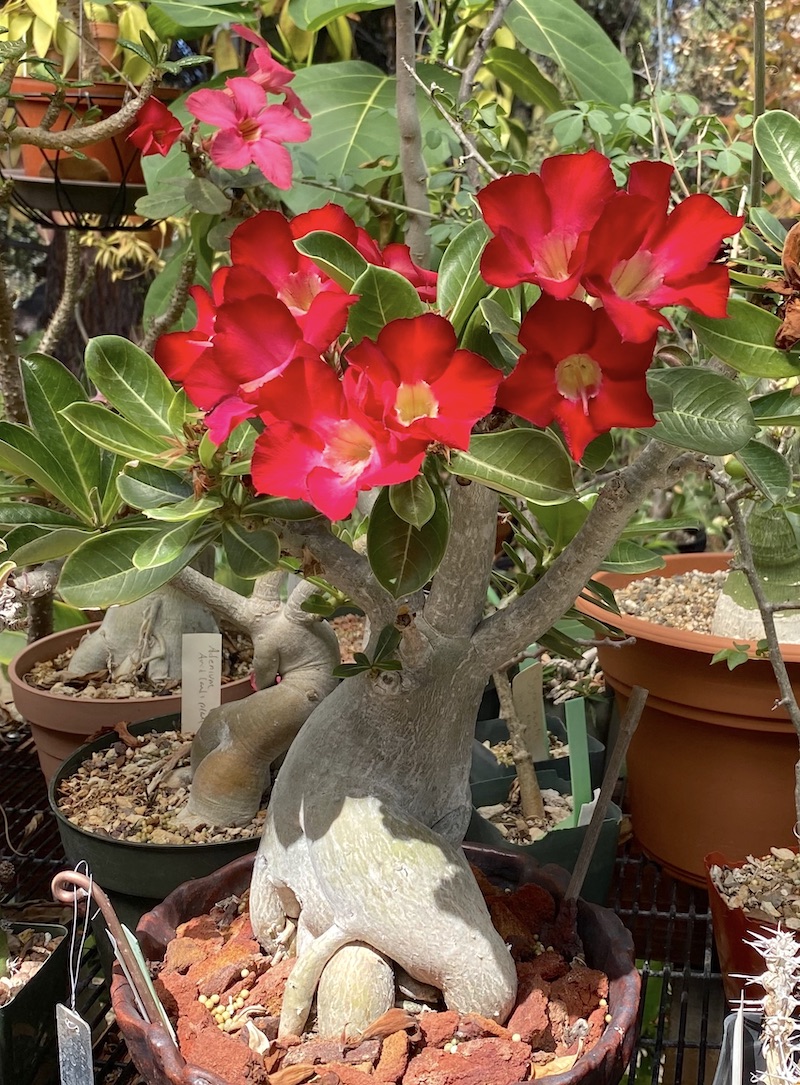
Fat-trunked succulent with bright red, rose-like flowers Adenium obesum (c) Debra Lee Baldwin

Adenium obesum cultivar

Could do this yourself? Certainly. Start now! Years pass quickly, and one joy of these plants is minimal effort---providing of course you observe a few essential guidelines.

For example, they tend to stay small unless you speed them up. To help his pachyforms attain show-worthy size, Julian suggests you...

Give roots more room

Roots with ample space better promote growth of branches, leaves and larger trunks. Julian first grows pachyforms in the ground, a raised bed, or a large (20-gallon) container. In a few years, when the plant's size pleases him, he transplants it into a show-worthy, artist-designed ceramic pot.

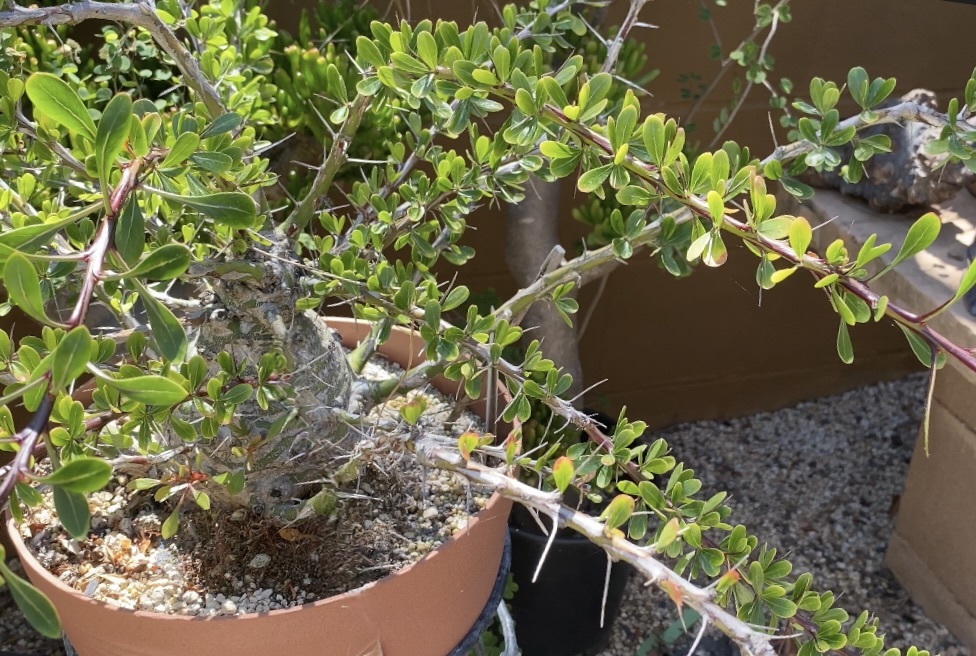
Prickly-stemmed fat-trunked caudiciform with small leaves related to ocotillo Fouquieria purpusii (c) Debra Lee Baldwin

Fouquieria purpusii

Bonsai succulents that impress judges at Cactus and Succulent shows tend to be large in proportion to their pots. Note: Such plants are not true bonsai, which is an ancient tradition with strict guidelines, and is mainly about miniaturizing woody trees and shrubs.

Ficus seedlings pre-bonsai (c) Debra Lee Baldwin

Ficus seedlings pre-bonsai

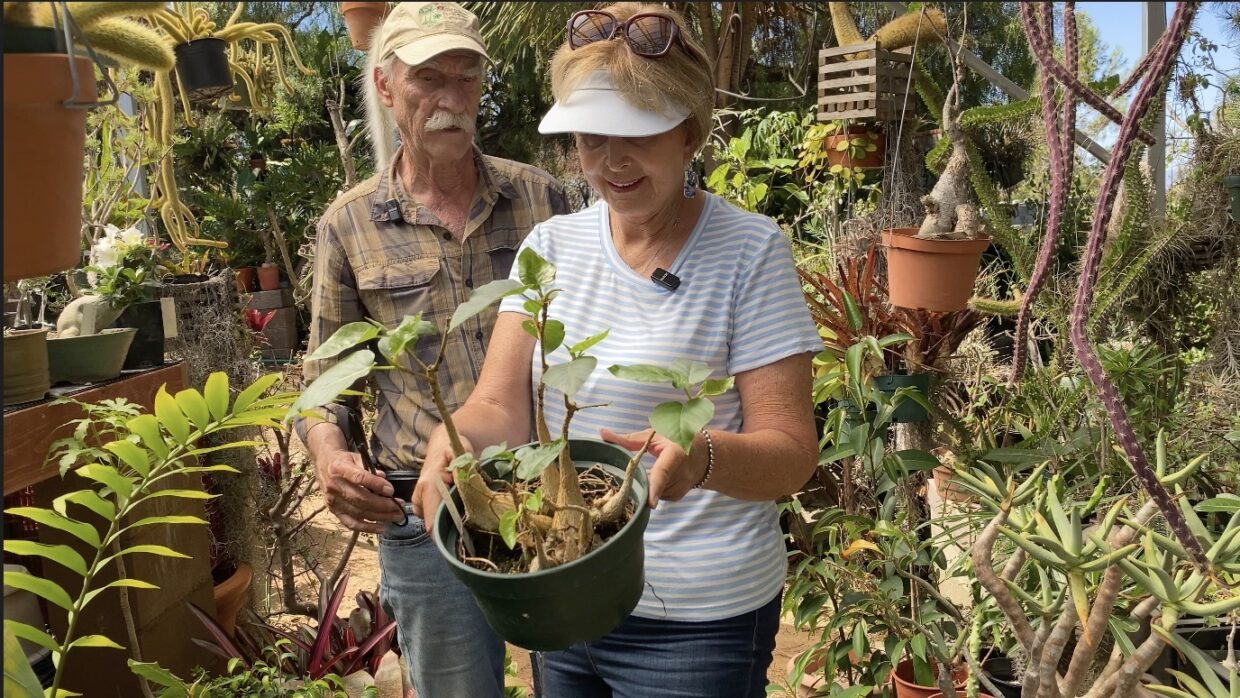
The ever-engaging Julian---who prior to retirement was often on TV---shows us his favorites, gives their ages, and explains what he finds fascinating about them.

Does it harm pachyforms to expose their roots?

When repotting potential bonsai specimens, succulent collectors elevate topmost roots above the soil. Why? They're too interesting not to show off! Collectors compare revealing the roots to opening a gift. Each set is unique.

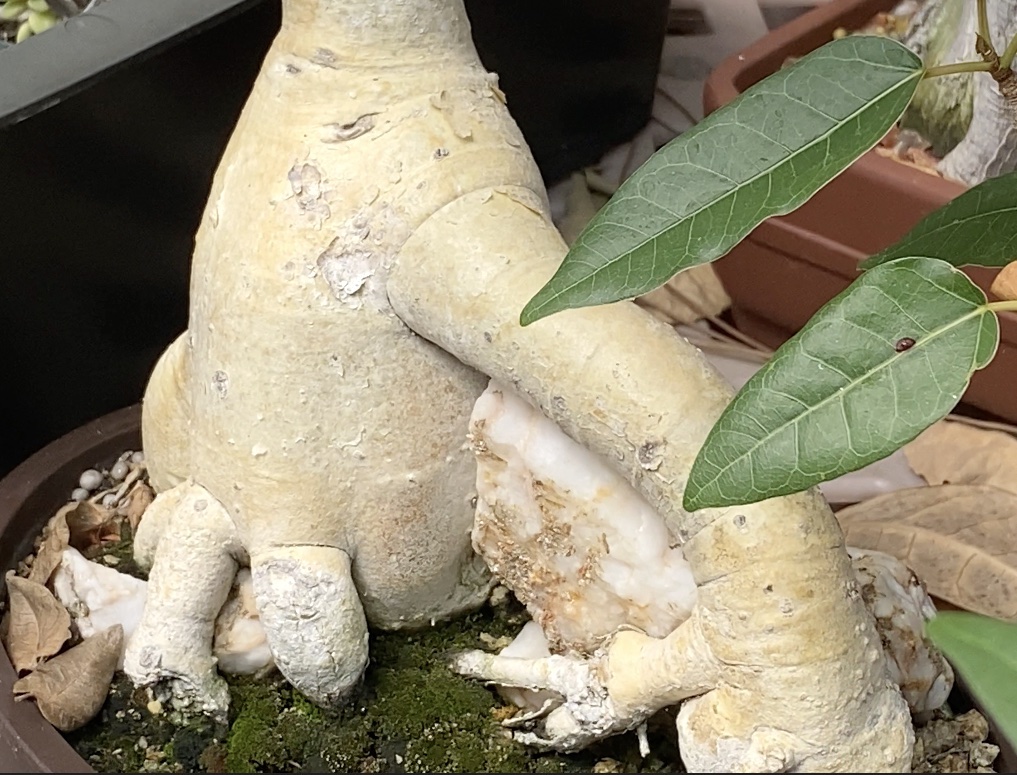
Bonsai succulent with roots encircling a quartz rock Ficus bonsai (c) Debra Lee Baldwin

Julian trained roots of this bonsai'd Ficus palmeri to grow around a rock

Granted it's an acquired taste, but once you uncover roots that suggest sausages, eels, or reclining nudes, you'll be hooked.

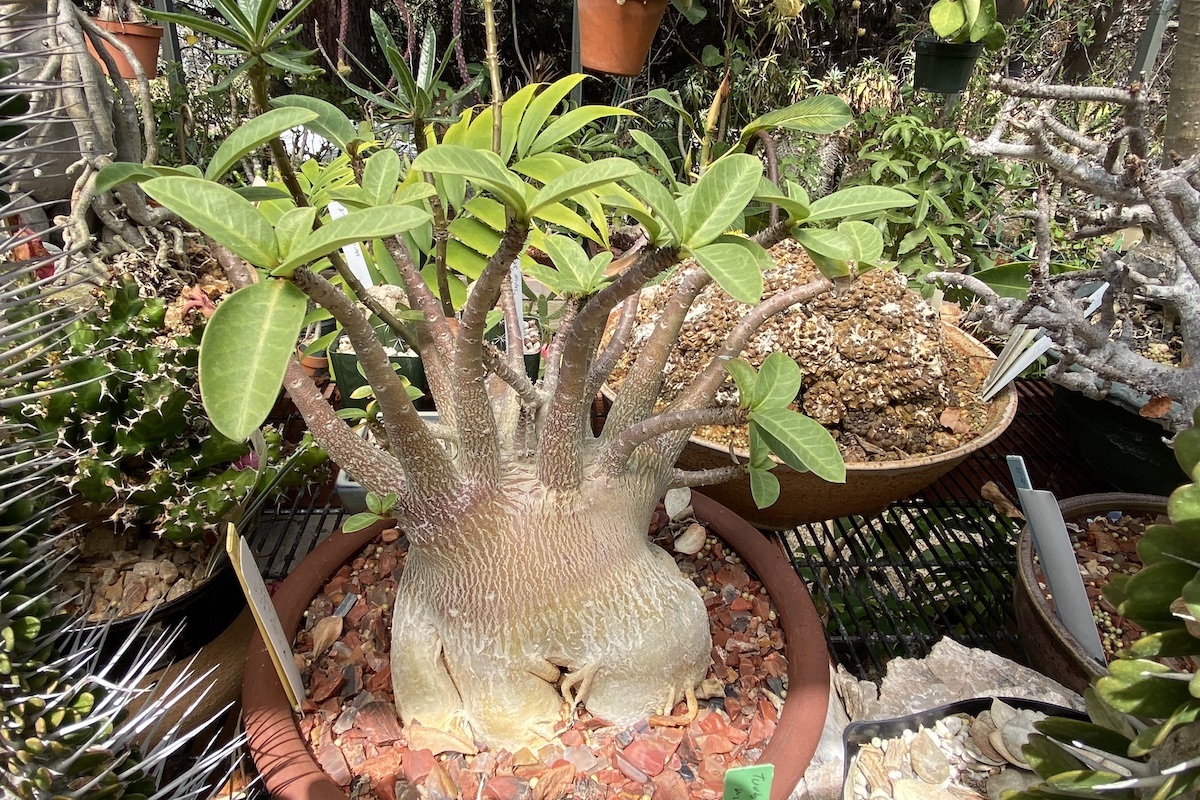
Fat-bottomed succulent with thick stems coming out the top and green leaves Adenium arabicum (c) Debra Lee Baldwin

Adenium arabicum

Because roots were in darkness, at first they'll need sun protection. Bulbous exposed roots soon harden off, match the color of the trunk, and appear to be a seamless extension of it. Most collectors snip stringy, straggly roots to better showcase larger, more dramatic ones.

Winter-dormant summer-growers

Here in Southern California it’s challenging to cultivate succulents from regions of the world with dry winters and rainy summers---often true of the stout-trunked varieties that collectors prize. CA's rainy season is October through April.

Fat-trunked succulent tree with small leaves and a tapered golden yellow trunk Dorstenia gigas (c) Debra Lee Baldwin

Dorstenia gigas hunkers down on a table in Julian's "plant port" rain shelter

Pachyforms are sensitive to cold and wet while sleeping (can you blame them?). During winter dormancy, they're vulnerable to rot---one reason they're uncommon in CA.

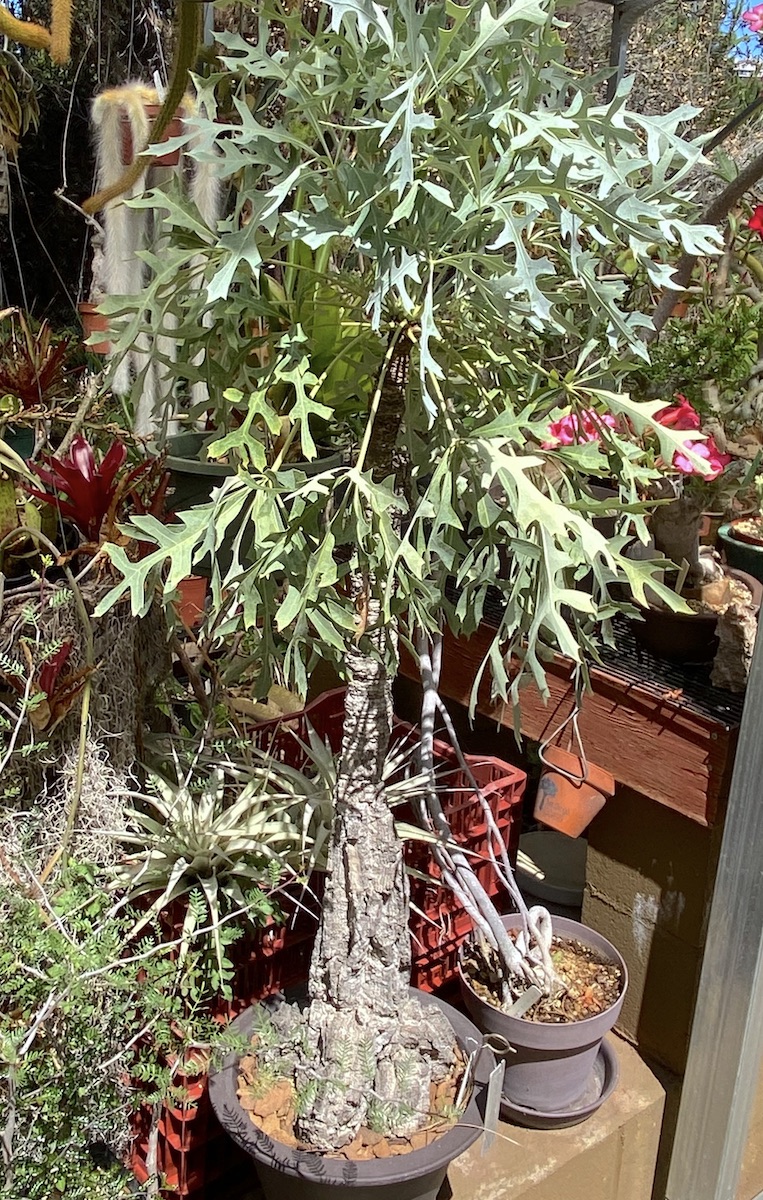
Tree with large silvery green feathery leaves, knobby trunk Cussonia paniculata (c) Debra Lee Baldwin

Cussonia paniculata

How does Julian keep pachyforms happy and healthy for decades?

Through trial and error, he's learned which have to be sheltered, and the best soil mix for rot-prone roots.

His "plant port" structure serves as an umbrella to keep winter rain from soaking potted, bonsai'd, winter-dormant summer-growers.

Julian notes: "Of course, not all plants fall neatly into categories. Some are more adaptable. For instance, in central Baja, many plants are primarily winter growers---but the area also receives occasional monsoon summer rains."

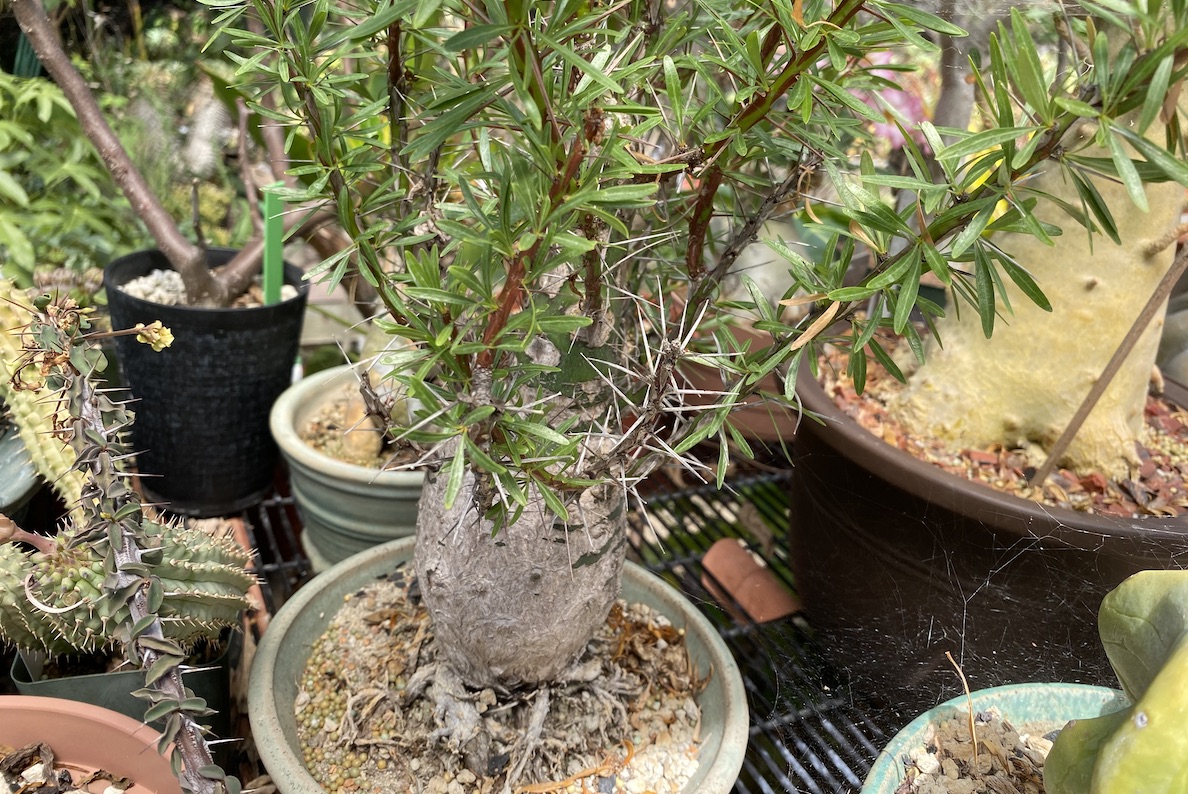
Succulent with spiky stems, small leaves and a bottle-shaped base Fouquieria fasciculata (c) Debra Lee Baldwin

Fouquieria fasciculata

He adds that succulents in small pots shouldn't be allowed to go bone dry. "Give a little water in winter for summer growers and some water in summer for winter growers," he advises.

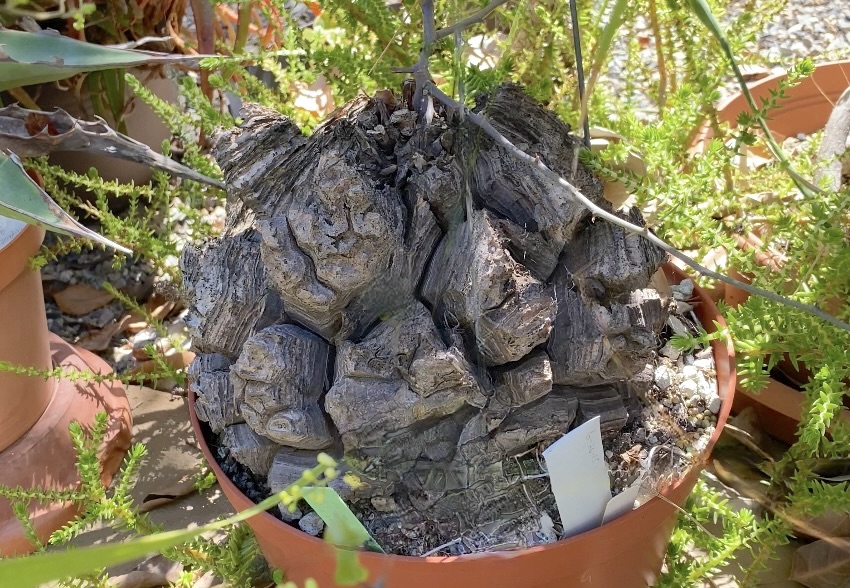
Plant with globular base woody dark gray, with stacked knobs Dioscorea elephantipes (c) Debra Lee Baldwin

Dioscorea elephantipes

It also helps that Julian's area is frost-free. (There's more about his locale in the first video.) Potential bonsai pachyforms that can handle some winter rain and temps into the 40sF---such as ficus and beaucarneas---start as cuttings in large pots. As roots spread, top growth takes off.

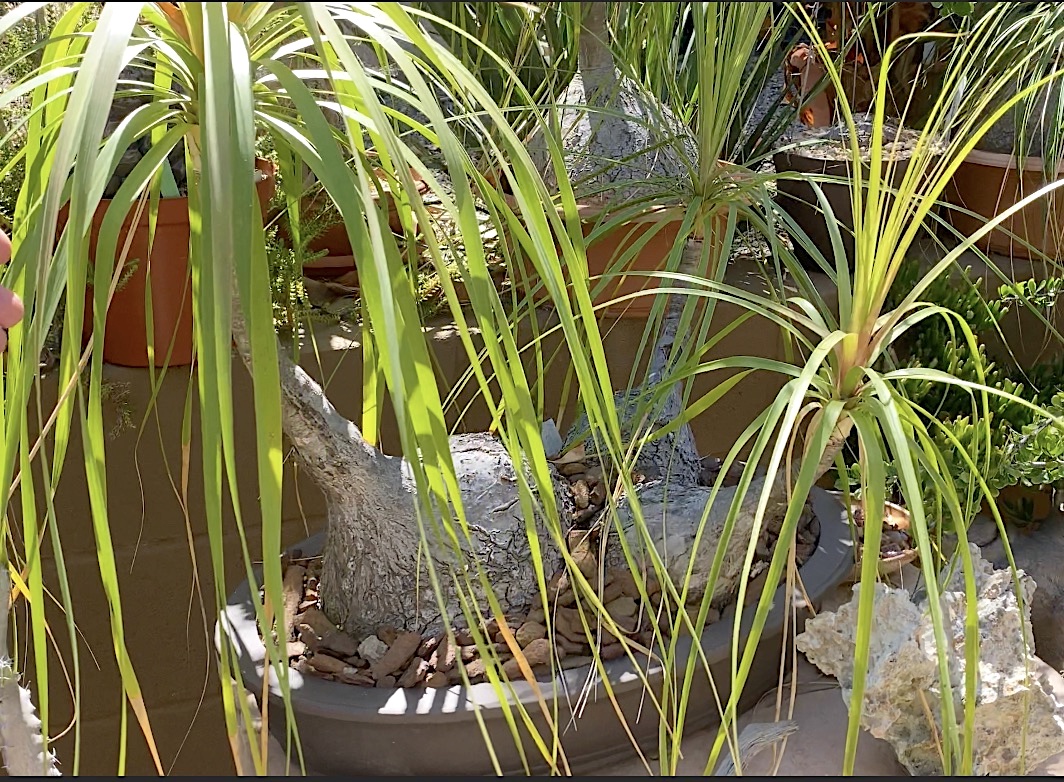
Ponytail palm looks like a green mop atop a gray suction cup Beaucarnea recurvata (c) Debra Lee Baldwin

Beaucarnea recurvata trio in a bonsai pot

Julian uses 20-gallon nursery pots ("tubs") filled with nutrient-rich, fast draining soil.

Start them in a raised bed 

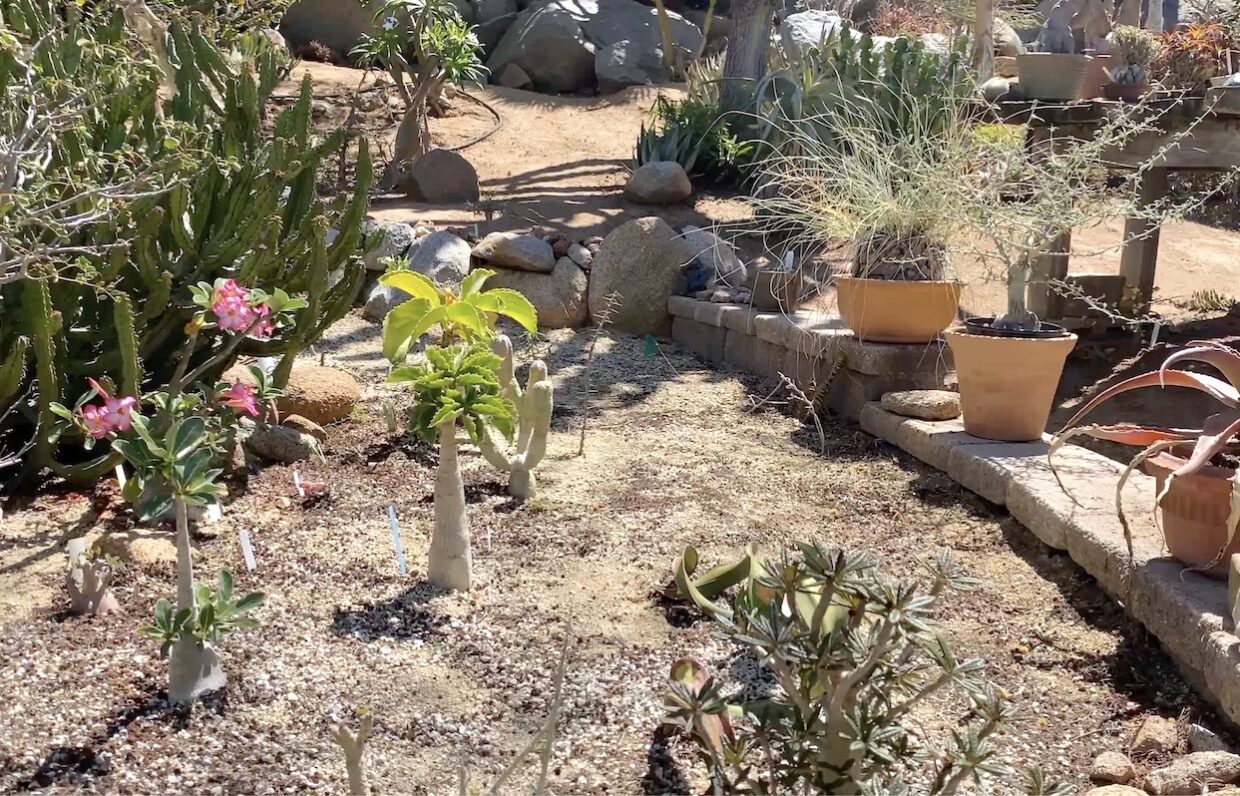
A terrace Julian filled with decomposed granite (DG) and coarse river sand allows summer-growing, winter-dormant pachyforms---such as adeniums and cyphostemmas---to grow in the open garden year-round. “I want them BIG,” Julian says.

Raised bed with fast-draining soil for succulents (c) Debra Lee Baldwin

Julian's raised bed

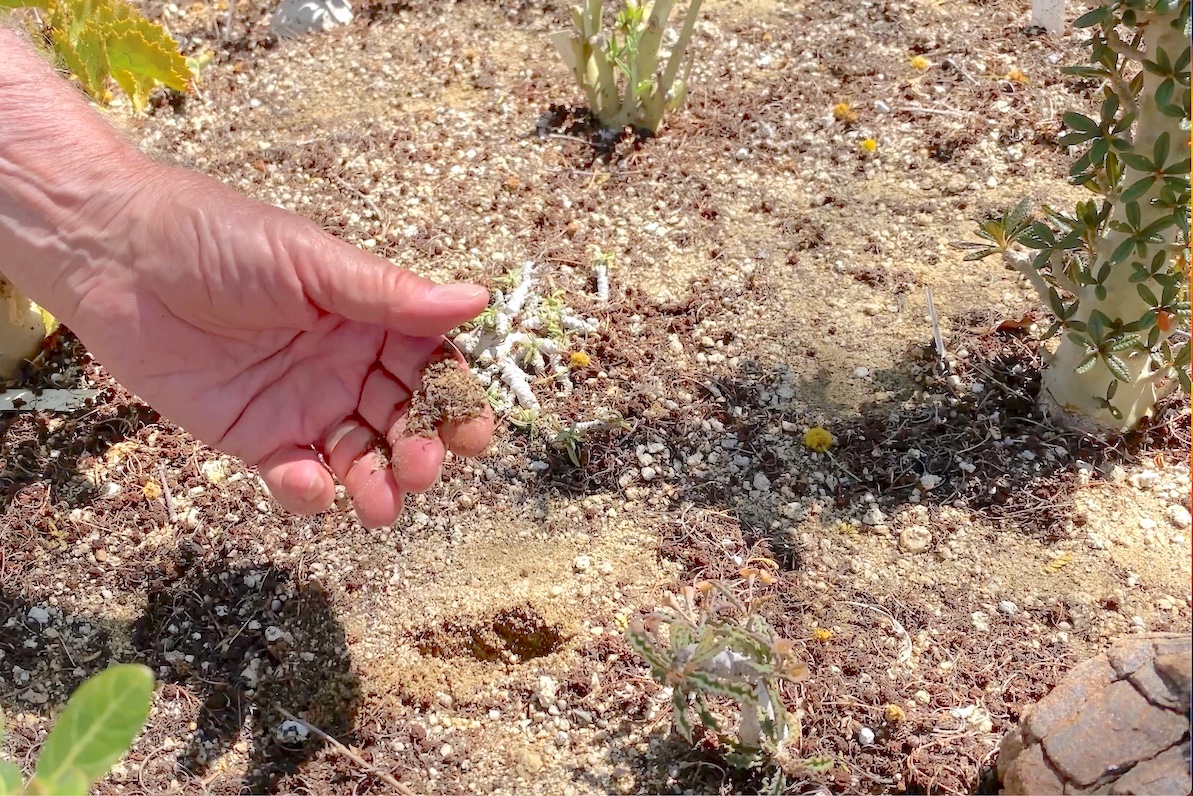
The bed protects roots from excessive rain, because DG drains rapidly. In the video you'll hear him say, "This one has gone through four winters," and, "you never know what they'll do until you try."

Julian says: “My raised bed is approximately 3/4 commercial decomposed granite and 1/4 washed or builders sand. Turns out the commercial DG had too much dust in it, so if I were to do it over, I would probably use maybe half pumice with the DG. But the pumice would need to be washed to get rid of most of its dust, which becomes almost like concrete. That also goes for pumice in potting mixes.”

Julian does a deep dive into soil 

Soil that drains well is essential to all succulents' survival. Clay soils found in much of Southern CA drain poorly, and soils with organic matter tend to retain water. DG offers good drainage but is nutrient-poor.

Succulents prefer a gritty, fast draining soil high in DG (c) Debra Lee Baldwin

The soil in Julian's raised bed is a fast-draining, gritty mix of DG and pumice.

Julian says: “A good soil mix depends on many factors. It astonishes me how different growers achieve results with such a wide variety of different mixes for the same plants. If I were a commercial grower, I would have a standard mix. As I have lots of individual plants, even among pachycauls, I do a lot of ingredient tweaking.

“Depending on how xeric-adapted a plant is, my primary inorganic ingredients---pumice and Turface---make up to 75%, with coir as the organic component.

“A big factor in considering how well-draining a mix should be is how often you water. The size and shape of a pot also factor in. Many of mine are in pots that are small relative to the size of the plant. For some, I may add a bit more water-retaining material such as coir. An alternative to coir is peat.

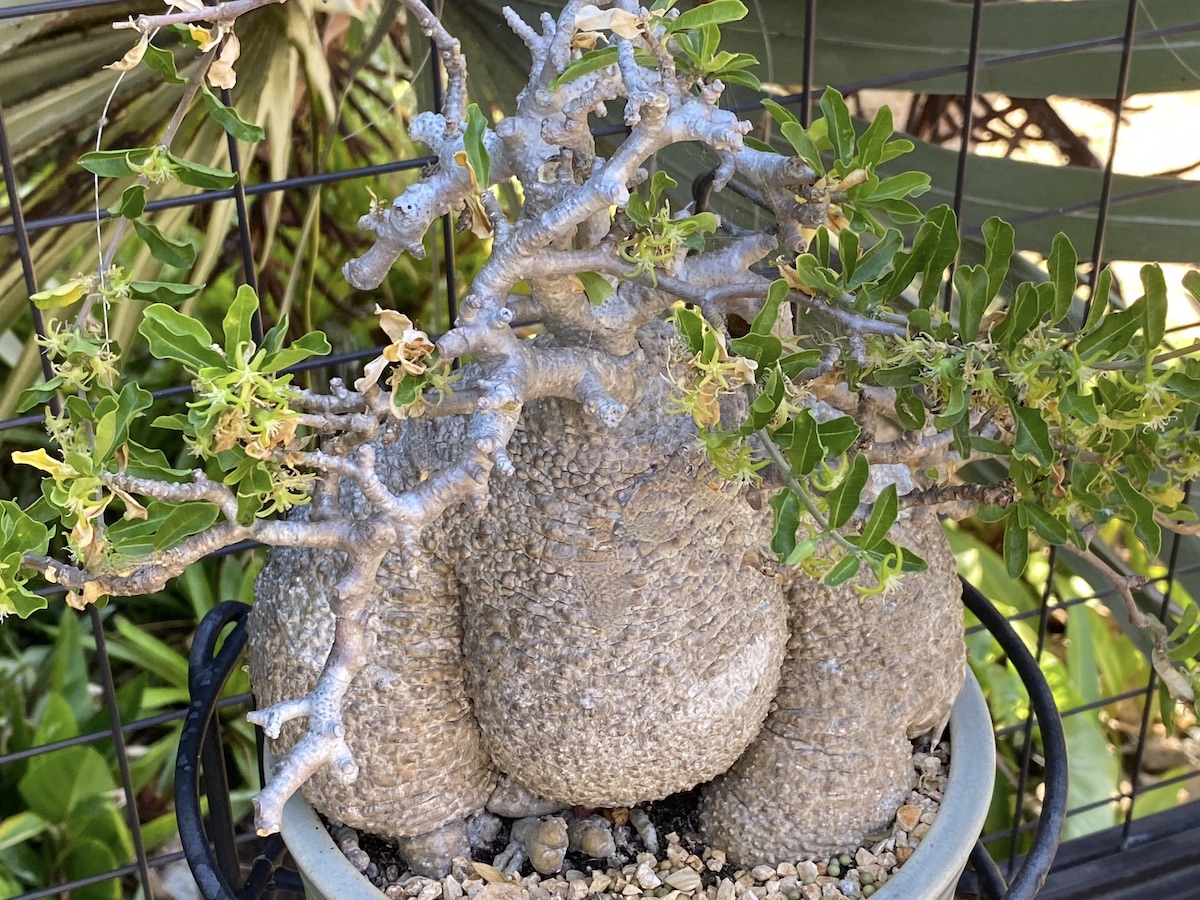
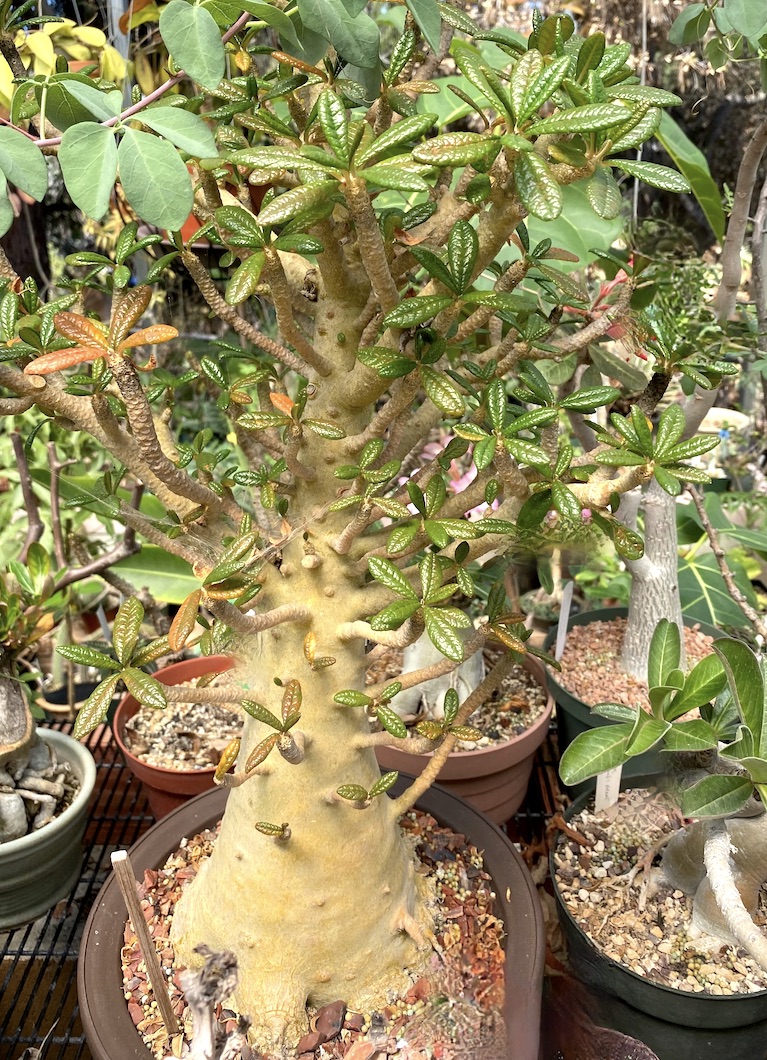
Fat-stemmed succulent with bumpy skin, gnarled pale gray branches Fockea edulis (c) Debra Lee Baldwin

Fockea edulis

“I’m not only tweaking mixes for individual plants, I’m also still learning. For the longest time I had an aversion to perlite. Mostly because I didn’t like the way it made a mix look. Not that it’s a sound reason. But recently I’ve beginning to use it.

"Turns out perlite has the capacity to maintain air space (which is important to almost all plants) while also retaining moisture. Feeder roots need water to uptake essential nutrients. Pumice and the commercial product Turface do this too, but perlite holds more moisture.

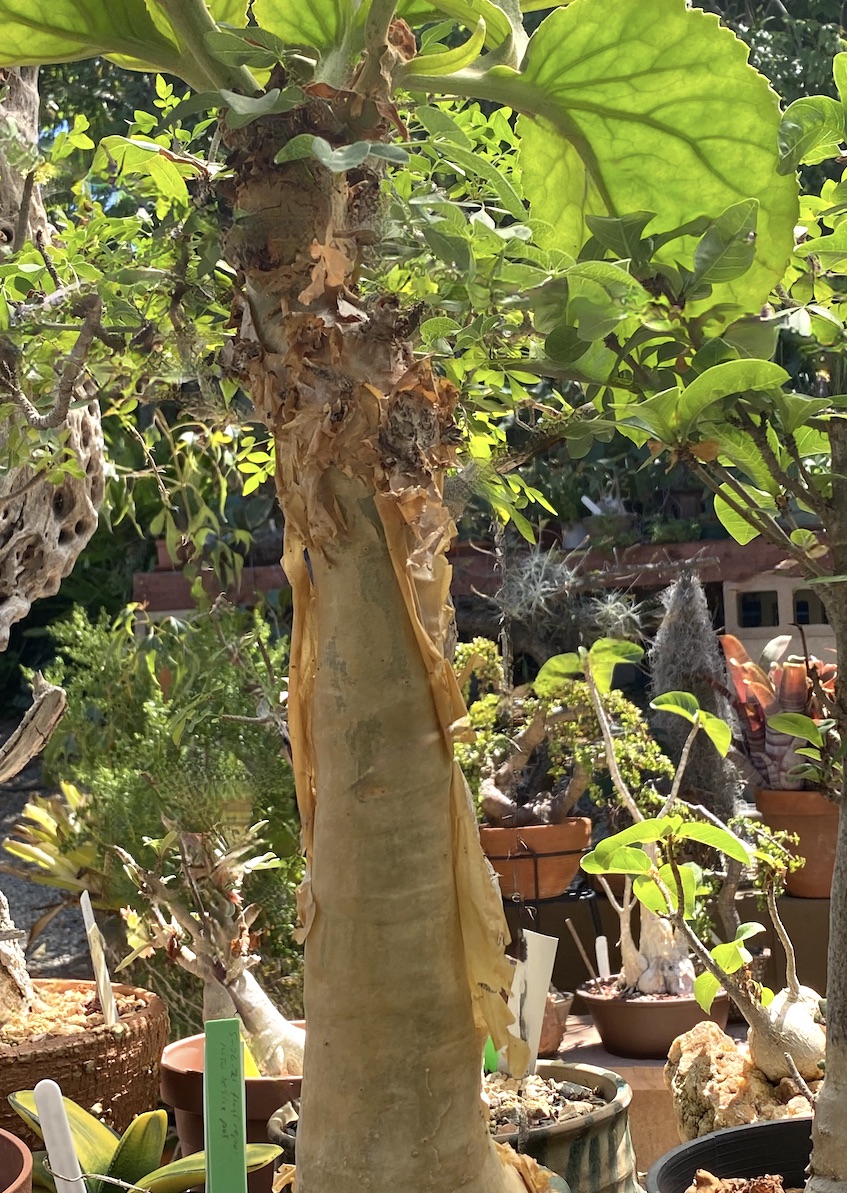
Succulent with greenish-yellow bark that peels in papery sheets Cyphostemma currorii (c) Debra Lee Baldwin

Cyphostemma currorii

“Just to confuse things even more, sometimes I also use ingredients that bonsai practitioners use, like scoria, akadama and coarse silica sand."

Bursera fagaroides a good succulent for bonsai (c) Debra Lee Baldwin

Bursera fagaroides

What about fertilizer?

“That’s a lot easier to answer," Julian says. "I use slow release Osmocote or Nutricote. Osmocote releases nutrients on contact with moisture; Nutricote, with warmer temperatures."

About those plant tags

Throughout the video, you'll see Julian pull tags out of pots to check a plant's name, its nursery of origin, and its date of acquisition. Some go back to when he lived in Indiana ages ago.

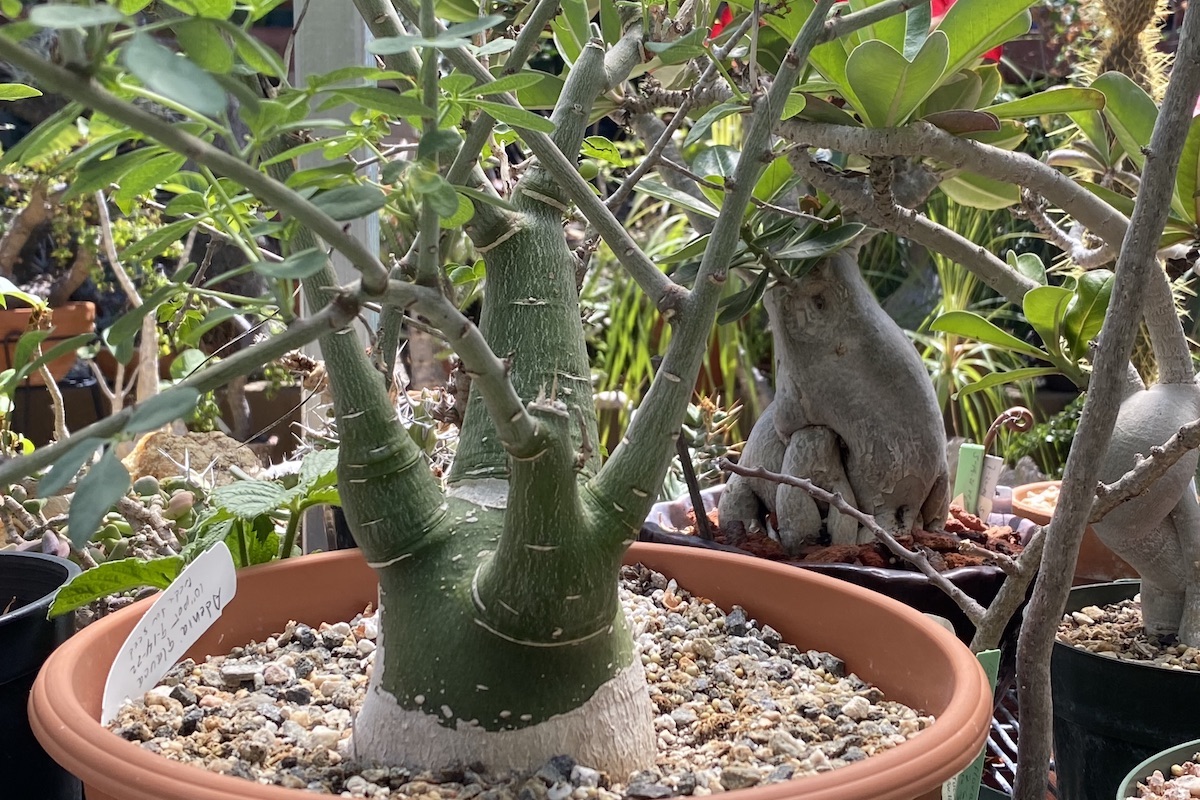
Succulent with fat bottom that's green on top, white on bottom Adenia glauca (c) Debra Lee Baldwin

Adenia glauca

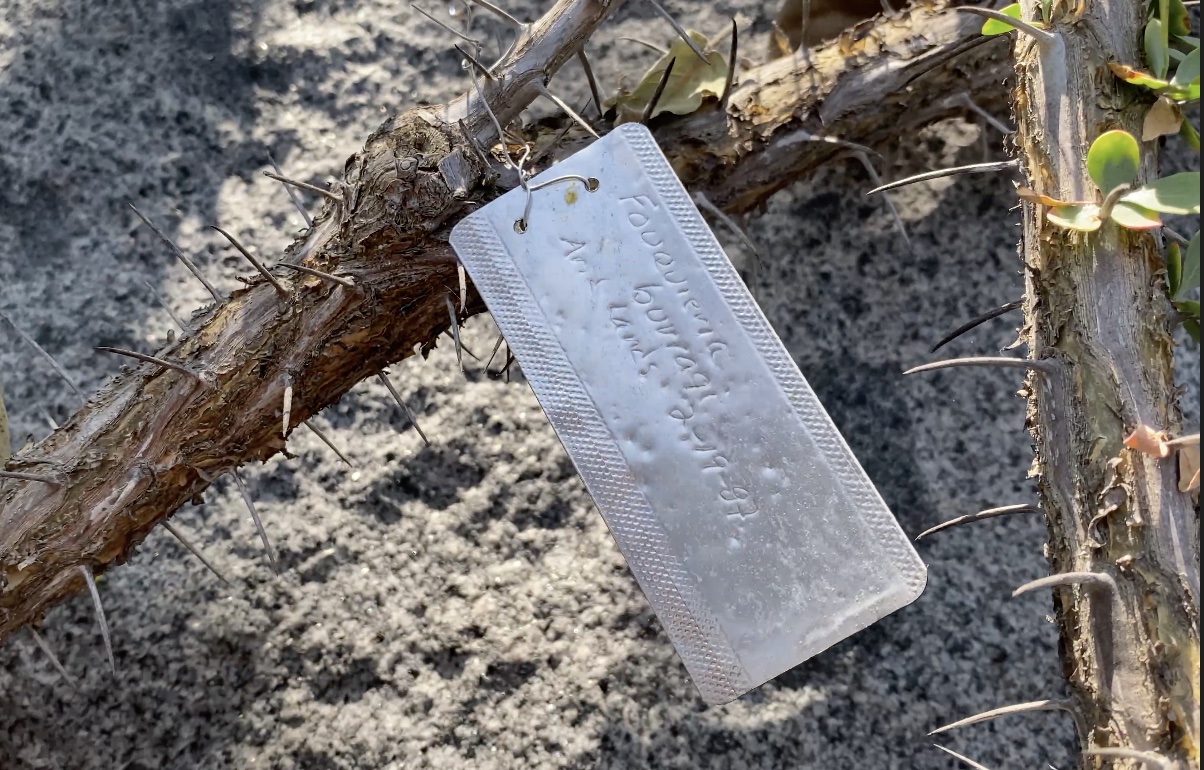
How do his nursery tags not deteriorate nor become illegible?

“Plant tags are a challenge," Julian says. "I’ve tried many different approaches. Pencil is still best for non-fading. But you still have to use a tag that is UV-impervious, or it’ll crumble over time. My attempt with metal Venetian blinds failed. I probably should try vinyl Venetian blinds.

Aluminum plant tag you write on with a pen (c) Debra Lee Baldwin

An aluminum plant tag reads: "Fouquieria bourragi, Arid Lands, 2-19-87"

“My current longer-term tags are aluminum that you emboss with a pen. But even those oxidize with time. If you can keep them from getting wet, they'll last longer."

Nurseries and experts Julian mentions

Julian often references the source nursery, grower or expert from whom he got a plant. These include:

Best cactus & succulent nursery in Tucson (c) Debra Lee Baldwin

Bach’s Cactus Nursery, 8602 N. Thornydale Rd., Tucson, AZ. Family owned for 40 years. Over 11 acres of growing ground and greenhouses. Large selection of adeniums, agaves, aloes, columnar cacti, opuntia, yuccas, and soft succulents.

Botanic Wonders nursery, Sarver Lane, San Marcos, CA. Online sales; open to the public by appointment. Founders Al Klein and Anthony Neubauer specialize in odd, rare and collectible cacti, pachyforms, and bonsai. See my YouTube tour with Al, the article/gallery on this site, and my succulent bonsai how-to video with Anthony.

Dimmit Adeniums, Mark Dimmit, Tucson. Premier source of Adenium cultivars.

Phyllis Flechsig, retired owner of a nursery in Encinitas, CA. Phyllis is renowned among members of the San Diego Cactus & Succulent Society.

Dave Grigsby: Original owner of long-time, now-defunct (but still famous) Grigsby Cactus Gardens, Vista, CA.

Dylan Hannon: Curator of the conservatory and tropical collections at the Huntington Botanical Gardens, near Pasadena, CA.

Miles' to Go nursery, Miles Anderson, Cortaro, AZ. Succulent rarities, mail-order and bare-root. Ariocarpus, astrophytums, stapeliads, mammilarias, and more.

Did you miss my first Julian video?

Here you go:

Related info on this site

Julian Duval (c) Debra Lee Baldwin

Discover Julian Duval’s Personal Botanic Garden

You’re about to tour the garden of one of San Diego’s most endearing and knowledgeable plant experts: Julian Duval, retired CEO of the San Diego Botanic Garden. In my new video, you’ll see rare and unusual plants in pots, in the ground, and in an 18 x 24 greenhouse that Julian calls “a walk-in terrarium.”…

Euphorbia mammillaris variegated (c) Debra Lee Baldwin

Visit Botanic Wonders & See Al Klein’s Succulent Rarities

You think you like succulents? Al Klein of Botanic Wonders nursery calls them “an addiction.” Al is a comet on the cactus and succulent scene. It seems he’s everywhere, doing speaking engagements, selling on the show circuit, greeting nursery visitors, and sharing a lifetime of info and enthusiasm. Al’s story bubbles out of him as…

The post Secrets to Healthy, Happy Fat Plants (Pachyforms) appeared first on Debra Lee Baldwin. Copyright © Debra Lee Baldwin.


from Debra Lee Baldwin https://ift.tt/AUOdwHt
via IFTTT